

Table of Contents
- Signs Your Water Heater Is Failing: What to Watch For
- Strange Noises, Leaks, and Other Physical Warning Signs
- Water Quality and Supply Problems: Rusty Water, Low Pressure, and Lukewarm Showers
- Rising Utility Bills and the Age of Your Unit
- Water Heater Life Expectancy: How Long Should Yours Last?
- Repair vs Replace Water Heater: Making the Right Call
- Average Cost to Replace a Water Heater: What Homeowners Should Expect
- When to Call a Professional: Safety Risks and Next Steps
- Frequently Asked Questions
Last Updated: October 4, 2026
Signs Your Water Heater Is Failing: What to Watch For
Knowing the signs your water heater is failing can mean the difference between a quick repair and a flooded basement.
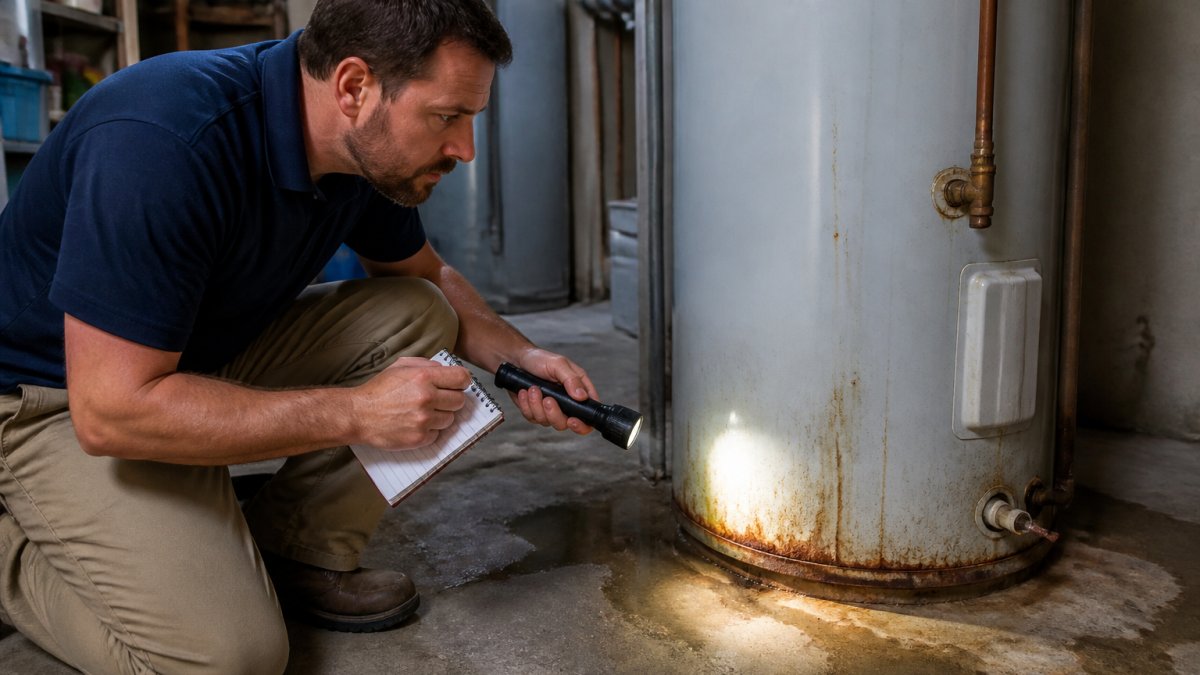
The pattern rarely changes: the signs your water heater is failing usually start small, a pop here, a rusty tint there, then stack up fast.
Below, we break down eight warning signs, what each one means, and when to call a professional.
Strange Noises, Leaks, and Other Physical Warning Signs
Noises and leaks are the two loudest signals a water heater sends, and both point to problems that get worse with time. The key is knowing which sound or drip maps to which failure mode, and which mean you shut the unit down today.
Popping, Banging, and Rumbling Sounds
Popping and banging come from sediment buildup on the tank floor.
Hard water speeds up mineral deposits, so homes with heavy scale see this earlier. Flushing clears mild sediment, but once popping is constant, the tank lining is often already damaged.
A few sound-to-cause patterns worth memorizing:
- Popping or crackling, sediment on the burner or element; flush the tank
- Banging or hammering, usually water hammer in the pipes, not the tank itself; check for loose pipe straps
- Rumbling or a low growl, heavy scale insulating the heat source; efficiency is already dropping
- Hissing, a leak or a failing pressure relief valve; shut the unit down
Tankless units rarely pop because there’s no standing tank of water to boil sediment. Instead, owners hear whistling or screeching, which usually means scale has built up in the heat exchanger.
Water Leaks, Puddles, and Corrosion
Any puddle around the base of the tank is a serious warning. Leaks usually start at the pressure relief valve, the fittings, or the tank itself, and corrosion at any of these points means metal is thinning.
Where the water shows up tells you a lot:
- Top of the tank, at the fittings, often a loose connection or a failed dielectric nipple; sometimes repairable
- Under the tank, at the base, usually a cracked tank; not repairable
- From the pressure relief valve or its discharge pipe, excess pressure or a failed valve; needs immediate attention
- Around the drain valve, often a worn washer or mineral buildup; usually a simple fix
Check the anode rod, the sacrificial metal that absorbs corrosion so the steel shell doesn’t. Once it’s spent, the tank corrodes from the inside, and a leaking tank cannot be repaired, only replaced.
On a tankless unit, leaks are less common but more serious.
If you see water pooling near the tank, shut off the gas or power and the cold water supply immediately. A tank that’s actively leaking can rupture without warning, and that means water damage across the whole floor. On a gas unit, also note that a leaking tank combined with a blocked flue can push carbon monoxide into the living space, if anyone in the home reports headaches, nausea, or dizziness, leave and call for help.
Tankless vs. Tank: How the Warning Signs Differ
Most guides treat every water heater as a tank, but the failure signatures differ enough to matter.
| Warning Sign | Tank-Style Indicator | Tankless Indicator |
|---|---|---|
| Noise | Popping, rumbling from sediment | Whistling, screeching from scale in heat exchanger |
| Leak | Puddle at tank base or fittings | Moisture at inlet/outlet or condensate line |
| Water quality | Rust-colored hot water | Rarely rusty; may show scale flakes |
| Temperature | Lukewarm, fading hot water | Cold-water sandwich, error codes, inconsistent output |
| Efficiency loss | Rising gas or electric bills | Longer heat-up times, cycling on and off |
On a tankless unit, watch for error codes on the display and inconsistent hot water at the tap. Both usually point to scale buildup or a failing flow sensor, and both are serviceable, unlike a cracked tank.
Water Quality and Supply Problems: Rusty Water, Low Pressure, and Lukewarm Showers
Changes in your water are often the first clue homeowners notice. Rust-colored water, weak pressure, and lukewarm showers all trace back to the tank.
Discolored or Rust-Colored Water
Rust-colored water from hot taps points straight at the tank interior. If cold water runs clear but hot comes out brown or reddish, corrosion is happening inside the water heater.
Sediment and scale can also tint the water and leave a metallic taste. Either way, discolored hot water means the tank is breaking down, and it’s a sign your water heater is failing that shouldn’t be ignored.
Reduced Hot Water Supply and Low Pressure
A dropping recovery rate means the heating element or burner is struggling. Showers that fade to lukewarm within minutes point to a failing element, a bad thermocouple, or heavy sediment insulating the water from the heat source.
Low water pressure on the hot side alone often means scale buildup in the pipes or at the tank outlet. If both hot and cold pressure drop, the problem may sit elsewhere in the plumbing.
Rising Utility Bills and the Age of Your Unit
Utility costs creeping up month after month often trace back to a water heater working harder than it should.
Age matters just as much. Most tank-style units last 8 to 12 years, tankless closer to 20.
Check the manufacturer’s label for the build date. If your unit is past its water heater lifespan and bills are climbing, replacement usually costs less than chasing repairs.
Water Heater Life Expectancy: How Long Should Yours Last?
Water heater life expectancy is the average number of years a unit operates before replacement becomes the smarter choice: typically 8 to 12 years for tank-style heaters, 18 to 20 for tankless with regular maintenance.
Several factors shorten that window:
- Hard water and mineral deposits that accelerate scale buildup
- Skipped annual flushing and anode rod checks
- A temperature setting above 120°F, which speeds corrosion
- Poor venting that strains a gas unit
If your unit is past its expected lifespan and showing two or more of the signs above, replacement is usually the better call.
Repair vs Replace Water Heater: Making the Right Call
The repair vs replace water heater decision comes down to age, repair cost, and how many problems are stacking up. A failed thermocouple on a 6-year-old tank is a clear repair; a leaking 12-year-old tank with rising bills is a clear replacement.
A useful rule of thumb: if the repair costs more than half a new unit and the existing unit is past the halfway point of its lifespan, replacement usually wins. It’s a starting point, not a hard rule.
The Decision Matrix
| Situation | Age of Unit | Recommended Action |
|---|---|---|
| Single failed part, no leaks | Under 8 years | Repair |
| Popping noises, rising bills | 8-12 years | Flush first; replace if symptoms return |
| Any tank leak or corrosion | Any age | Replace |
| Two or more warning signs at once | Over 10 years | Replace |
| Failed heating element or thermocouple | Under 8 years | Repair |
| Failed heat exchanger (tankless) | Any age | Replace, not serviceable |
| Repeated repairs in 12 months | Any age | Replace |
| Unit still under manufacturer warranty | Any age | Repair first, check warranty terms |
The Cost Math Behind the Decision
Repairs on a tank-style unit are usually straightforward: a thermocouple, heating element, or pressure relief valve is a same-day job with modest parts cost. A failed tank, cracked heat exchanger, or corroded flue climbs fast, and you’re still left with an old unit that will likely fail again.
When you compare repair versus replace, factor in:
- The repair quote itself
- The remaining lifespan of the existing unit
- Any efficiency gains from a newer model
- The cost of a second service call if the same unit fails again
Tankless vs. Tank: Different Repair Economics
Tankless units change the math. They last longer than tank-style heaters, but components, flow sensors, igniters, heat exchangers, can be expensive. A failed heat exchanger is almost always a replacement trigger, since the part cost approaches a new unit.
A tankless unit that’s simply scaled up often just needs descaling, far cheaper than replacement. If it’s throwing error codes or delivering inconsistent hot water, get a diagnostic before assuming the worst.
DIY Inspection Checklist: What You Can Check Safely
A basic inspection takes 10 minutes and can catch problems early. Stick to these steps, and stop at anything involving gas lines, electrical panels, or the pressure relief valve.
- Check the floor around the tank for puddles, moisture, or rust stains
- Look for corrosion on fittings, the pressure relief valve, and the tank base
- Test hot water at two taps to compare temperature and pressure
- Listen for popping, banging, or rumbling when the burner runs
- Note the build date on the manufacturer’s label
Write the build date on a piece of tape stuck to the tank. When a technician arrives, they’ll know the unit’s age in seconds, and you’ll stop guessing whether it’s worth repairing. The same trick works on tankless units, note the install date and the last descaling date.
When Repair Is the Wrong Call
Some failures aren’t worth repairing at any age:
- A tank that is actively leaking or shows corrosion at the base
- A cracked heat exchanger on a tankless unit
- A unit with a failed gas valve or a compromised flue
- A unit that has already had two or more major repairs in the past year
In each case, a repair just delays replacement and adds risk. A licensed plumber can confirm the diagnosis and give you a straight answer for your home.
Average Cost to Replace a Water Heater: What Homeowners Should Expect
The average cost to replace a water heater depends on tank size, fuel type, venting setup, and hauling away the old unit. A standard tank swap costs far less than converting to tankless, which may need new gas lines, electrical work, or venting.
Pricing varies by home, so we quote each job after seeing the unit and space. Classic Plumbing Solutions provides upfront pricing and gets your authorization before work begins, so there are no surprise charges. Project financing is available, along with senior and military discounts for qualifying homeowners.
When to Call a Professional: Safety Risks and Next Steps
Some problems are safe to watch. Others need a licensed plumber the same day.
Call a professional immediately if you see any of these:
- Water pooling around the tank or dripping from the base
- The smell of gas near a gas-fired unit
- Rust-colored water from every hot tap
- The pressure relief valve is dripping or stuck
- No hot water at all, or the pilot light won’t stay lit
Gas leaks, venting issues, and electrical faults are not DIY territory. A failed pressure relief valve can turn a tank into a projectile, and carbon monoxide from a blocked vent is a genuine health risk.
For anything short of those emergencies, a plumbing inspection gives you a clear answer on repair versus replace.
Frequently Asked Questions
How do I know if my water heater needs replacing?
Watch for a combination of warning signs: popping or banging noises from sediment buildup, rust-colored water, leaks or puddles around the tank, and a unit that is 10 to 12 years old. If you are also seeing rising utility bills or inconsistent hot water, replacement is likely the better option. A licensed plumber can confirm whether the tank integrity is compromised or if a simple repair will buy you more time.
What is the typical life expectancy of a water heater?
Tank-style water heaters generally last 8 to 12 years, while tankless models can last up to 20 years with proper maintenance. Hard water accelerates sediment buildup and shortens lifespan, so annual flushing helps. If your unit is past the 10-year mark and showing multiple failure signs, replacement is usually more cost-effective than repeated repairs.
What is the most common cause of water heater failure?
Sediment buildup is the leading cause. Minerals settle at the bottom of the tank, forcing the heating element to work harder and causing popping sounds. Over time, this leads to overheating, tank corrosion, and premature failure. Regular flushing and checking the anode rod can extend the unit’s life and prevent unexpected breakdowns.
Can a failing water heater cause a flood?
Yes. A corroded tank or a failed pressure relief valve can rupture and release dozens of gallons of water, causing significant water damage. If you see moisture, rust streaks, or a dripping valve, shut off the water supply and power to the unit immediately, then call a plumber. Prompt attention prevents a small leak from becoming a flooded basement.
