

Table of Contents
- The 12-Year Threshold: What It Means for Your Water Heater
- Average Water Heater Lifespan: How Long Do They Really Last?
- Signs of a Failing Water Heater You Shouldn’t Ignore
- Cost of Water Heater Repair vs Replacement: A Financial Breakdown
- Comparing Repair and Replacement Options: A Decision Guide
- Common Water Heater Problems and What They Cost to Fix
- DIY vs. Professional Installation: Safety, Code, and Warranty Risks
- How Hard Water and Local Conditions Affect Your Decision
- Frequently Asked Questions
Last Updated: September 19, 2026
The 12-Year Threshold: What It Means for Your Water Heater
A 12-year-old water heater is generally not worth repairing if the fix costs more than half the price of a new unit. Most tank-style heaters last 8 to 12 years, so at 12 years you are at the outer edge of expected service life. At Classic Plumbing Solutions, we have walked Roanoke Valley homeowners through this decision, and the math rarely favors a major repair.
How Age Affects Water Heater Lifespan and Efficiency
Service life is how long a water heater can reasonably be expected to operate before failure becomes likely, typically 8 to 12 years for tank units.
Average Water Heater Lifespan: How Long Do They Really Last?
The average water heater lifespan depends on the type of unit. Tank-style heaters usually last 8 to 12 years, while tankless and heat pump models often run longer with proper care.
Tank vs. Tankless vs. Heat Pump: Life Expectancy by Type
| Type | Typical Lifespan | Key Weak Point | Best For |
|---|---|---|---|
| Tank (gas or electric) | 8-12 years | Tank corrosion, sediment | Households needing stored hot water |
| Tankless | 15-20 years | Scale accumulation | Homes with hard water and light demand |
| Heat pump | 13-15 years | Compressor wear | Mild climates, efficiency-focused homes |
A 12-year-old tank unit sits at the end of its range. A 12-year-old tankless unit may still have years left, which changes the repair calculus entirely.
Signs of a Failing Water Heater You Shouldn’t Ignore
The clearest signs of a failing water heater are rust-colored water, rumbling noises, visible leaks, and inconsistent hot water, any one signals the unit is near the end of its service life.
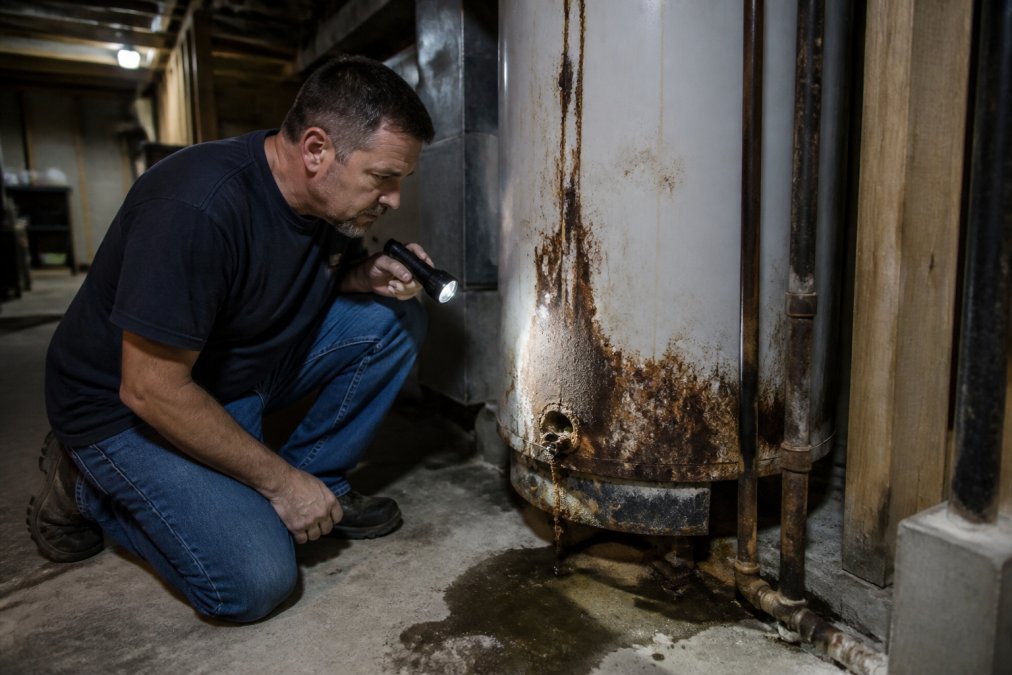
Rust-Colored Water, Strange Noises, and Leaks
Rust-colored water from hot taps usually means the tank interior is corroding, a terminal problem, not a repair item. Strange noises like popping or rumbling point to sediment buildup; flushing helps early on, but at 12 years the sediment is often baked onto the tank floor. Structural leaks at the tank seam or base cannot be patched reliably, a leak at a fitting or the pressure relief valve is sometimes fixable, but a leak from the tank body means replacement.
If you see water pooling around the base of the tank, shut off the gas or power and the water supply before anything else. A tank that fails completely can release dozens of gallons into your home and create a flooding risk that costs far more than the heater itself.
Cost of Water Heater Repair vs Replacement: A Financial Breakdown
The cost of water heater repair vs replacement comes down to one question: how much of the unit’s remaining value does the repair consume? Because pricing shifts with local labor rates, brand, and venting, get a written quote rather than relying on a national average.
Typical Repair Costs by Component
| Repair | Typical Cost Range | Notes |
|---|---|---|
| Thermocouple / pilot assembly | $150-$300 | Cheapest common fix; often worth doing even at 12 years |
| Heating element (electric) | $200-$400 | Higher on an aging tank because scale accelerates re-failure |
| Gas control valve / thermostat | $300-$600 | Parts cost dominates; labor is modest |
| Pressure relief valve | $150-$350 | Sometimes fixable; a tank-body leak is not |
| Dip tube | $200-$400 | Rare, but a failed dip tube mimics a dead heater |
| Sediment flush (preventative) | $100-$250 | Preventative, not curative, once scale is severe |
Typical Replacement Costs by Unit Type
| Unit Type | Typical Installed Cost | Key Cost Drivers |
|---|---|---|
| Standard gas tank (40-50 gal) | $1,200-$2,500 | Venting, gas line, permit |
| Standard electric tank (40-50 gal) | $900-$1,800 | Circuit capacity, permit |
| Tankless (gas) | $2,500-$4,500 | Venting, gas line upsizing, electrical |
| Heat pump water heater | $2,500-$4,500 | 240V circuit, condensate drain, space requirements |
A thermocouple or pilot assembly replacement is a small job. A failed heating element on an aging electric tank is a bigger warning sign. Multiple failures in one year usually mean the unit is done.
The 50% Rule and When Repair Makes Sense
The 50% rule is a simple guideline: if a repair costs more than half the price of a new installed unit, replace it. This is a cost-benefit analysis, not a hard law.
- Repair makes sense when the unit is under 8 years old and the fix is minor
- Repair is borderline between 8 and 12 years if the issue is a single inexpensive part
- Replacement wins at 12 years for any repair beyond a small component swap
The Insurance and Liability Angle Most Guides Skip
A 12-year-old tank is at or past the upper end of the manufacturer’s expected service life. If it fails and releases water into your home, your insurance claim can be scrutinized, and in some cases denied or reduced, if the adjuster determines the loss resulted from a known worn-out appliance you chose not to replace.
Before you authorize a repair on a 12-year-old tank, check your homeowner’s policy language on ‘gradual damage’ and ‘wear and tear.’ If the tank later fails and the claim is denied, the repair money is gone and the water damage is on you.
When the Repair Still Wins
Repair can still make sense when:
- The unit is under 8 years old and the fix is a single inexpensive part
- The failure is clearly a component issue (thermocouple, element) with no rust, no tank leak, and no sediment noise
- You are selling within a year and the buyer’s inspector has flagged the unit
- You have documented maintenance (annual flushes, anode rod checks) and the tank interior is clean
At 12 years, though, the burden of proof shifts. The repair has to be cheap, the tank has to be clean, and you have to accept that you are buying months, not years.
Comparing Repair and Replacement Options: A Decision Guide
The right choice depends on age, the specific failure, and how long you plan to stay in the home:
| Situation | Recommended Path | Why |
|---|---|---|
| Under 8 years, minor part failure | Repair | Plenty of service life remains |
| 8-12 years, single cheap part | Repair, then plan ahead | Buy time, budget for replacement |
| 12 years, tank leak or rust | Replace | Tank failure cannot be repaired |
| 12 years, second repair this year | Replace | Pattern of failures signals end of life |
| Any age, repeated leaks | Replace | Safety and flooding risk outweigh savings |
Common Water Heater Problems and What They Cost to Fix
The most common problems are a failed thermocouple, a bad heating element, sediment buildup, a stuck pressure relief valve, and thermal expansion stressing the tank. A thermocouple or pilot assembly issue is usually the cheapest fix and often worth doing even on an older unit. A heating element replacement costs more and, on a 12-year-old tank, is often the last repair before replacement.
Ask any plumber to show you the failed part before they replace it. At Classic Plumbing Solutions, we authorize every repair with you before work begins, so you never get a surprise line item after the job starts.
DIY vs. Professional Installation: Safety, Code, and Warranty Risks
DIY repair is tempting on a 12-year-old unit, but the risks are real. Gas connections, venting requirements, and plumbing code compliance are not beginner territory. A botched gas connection or improper venting can create carbon monoxide hazards.
On a 12-year-old heater, the repair decision is really a safety and liability decision. A licensed plumber protects you on code, warranty, and insurance.
How Hard Water and Local Conditions Affect Your Decision
Hard water is the biggest variable most homeowners overlook, and it can move a water heater’s real-world lifespan by several years. Minerals coat the heating element, insulate the tank floor, and speed up tank corrosion. In hard water areas, a heater that would last 12 years elsewhere may fail at 9.
What ‘Hard Water’ Actually Means in Numbers
Water hardness is measured in grains per gallon (gpg) or milligrams per liter (mg/L) of calcium carbonate. Water hardness is classified as:
| Classification | Hardness (gpg) | Hardness (mg/L) |
|---|---|---|
| Soft | 0-3.5 | 0-60 |
| Moderately hard | 3.5-7 | 61-120 |
| Hard | 7-10.5 | 121-180 |
| Very hard | 10.5+ | 180+ |
How to Estimate Your Own Water’s Impact
You do not need a lab to get a useful read:
- Check your municipal water quality report. Most utilities publish an annual Consumer Confidence Report listing hardness in mg/L or gpg, free and usually posted on the utility’s website.
- Test at the tap. Inexpensive test strips or a drop-count kit give a rough gpg reading in minutes. For a precise number, a certified lab test is worth it if you are deciding between repair and replacement.
The Two Mechanisms That Kill Tanks Early
Scale accumulation is the first. Calcium and magnesium precipitate out of heated water and settle on the tank floor and heating element. On a gas unit, that sediment insulates the burner flame from the water, so the tank overheats the steel at the bottom, the exact place corrosion starts. On an electric unit, scale coats the element, which runs hotter and burns out faster.
What Actually Changes the Math
If your 12-year-old unit has lived its whole life in hard water with no softener and no annual flushing, assume the sediment layer is thick and remaining life is short, lean toward replacement even for a mid-priced fix. If you have a softener, or flushed annually and replaced the anode rod at least once, a 12-year-old unit may still have usable life, and a single inexpensive repair can be reasonable, but plan replacement within the next year or two.
If your water tests above 7 gpg, budget for a softener alongside the new heater. A softener can help extend service life and cut the energy penalty from scale buildup.
Homeowners on a fixed income or with a failing 12-year-old tank who need financing options and upfront pricing before work begins.
Frequently Asked Questions
How long will a 12-year-old water heater last?
Most tank water heaters last 8 to 12 years, so a 12-year-old unit is already at the end of its expected service life. While it may continue working, the risk of sudden failure, leaks, and flooding increases each year. If you have hard water, the lifespan can be even shorter due to sediment buildup and tank corrosion. At this age, planning for replacement is smarter than waiting for an emergency.
What are the signs that a water heater is failing?
Watch for rust-colored water, rumbling or popping noises, moisture around the base, and inconsistent hot water. A pilot light that keeps going out or a thermocouple that fails repeatedly also signals trouble. If you see any of these signs on a 12-year-old unit, repair costs can quickly approach replacement costs, making a new water heater the better investment.
Should a 15-year-old water heater be replaced?
Yes. A 15-year-old water heater is well past its average lifespan and likely has worn components, corrosion, and reduced efficiency. Repairing it is rarely cost-effective because parts may be hard to find and the tank itself could fail soon after. Replacement with a modern, energy-efficient model will save on utility bills and prevent water damage.
Is it normal for a water heater to last 20 years?
It’s uncommon. Most water heaters last 8 to 12 years, and reaching 20 years is rare. Units that last that long typically have had annual maintenance, including flushing to remove sediment and replacing the anode rod. Without that care, a 20-year-old water heater is a liability. If yours is that old, schedule a professional inspection to assess its condition and safety.
