

Table of Contents
- What Counts as a Plumbing Emergency (And What Can Wait)
- Your Plumbing Emergency Checklist: First Steps Before Help Arrives
- Common Plumbing Emergencies in Roanoke Valley Homes
- Licensed Plumber Verification: How to Check Credentials Fast
- 24/7 Emergency Plumber Cost: What Affects Your Bill
- Why Local Matters: Roanoke Valley Infrastructure and Response Times
- Frequently Asked Questions
Last Updated: September 16, 2026
What Counts as a Plumbing Emergency (And What Can Wait)
Water pouring through a ceiling at 2 a.m. is an emergency. A slow drip under the bathroom sink that’s been there for a week is not. Knowing the difference saves you money and keeps genuine crises from getting worse.
An emergency plumbing situation threatens property damage, health, or safety if left untreated for even a few hours.
Here’s the dividing line:
True emergencies (call now):
- Burst pipes or active flooding
- Sewage backing up into tubs, showers, or floor drains
- No water at all, or water that won’t shut off
- Gas odors near a water heater or gas line
- Water heater leaking from the tank itself
Can wait for business hours:
- A single slow drain
- A dripping faucet
- A running toilet
- Low water pressure on one fixture only
Never ignore a sewage backup or a gas smell near your water heater. Sewage carries bacteria that contaminate surfaces fast, and gas leaks are a safety issue, not a plumbing inconvenience. Leave the house and call for emergency service immediately.
Your Plumbing Emergency Checklist: First Steps Before Help Arrives
The first five minutes of a plumbing emergency determine how much damage your home takes. A plumbing emergency checklist is a short, ordered set of actions before the technician arrives: shut off the water, cut the power to affected fixtures, document the damage, and call for help. Most homeowners skip straight to the phone call, which can wait 30 seconds.
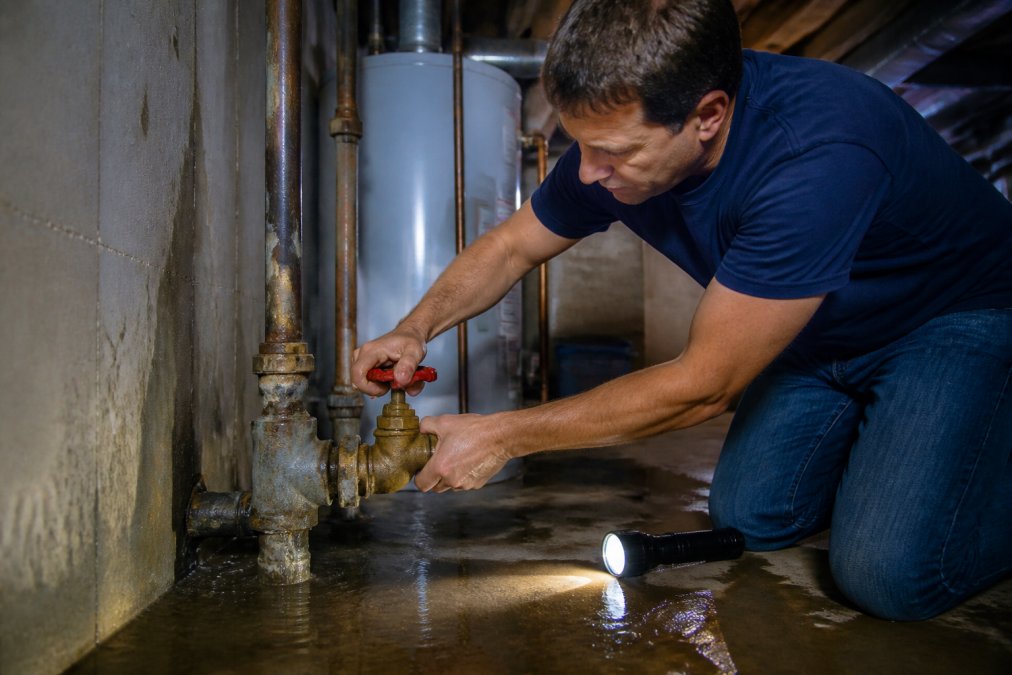
Shutting Off the Main Water Supply
Find your main water shut-off valve before you need it. It usually sits near the water meter, in the basement, or in a utility closet, and turning it clockwise stops water from entering the house entirely. In an older Roanoke Valley home the valve may be stiff from disuse, so test it once a year rather than discovering it’s seized during a flood.
DIY Temporary Fixes for Burst Pipes and Leaks
For a burst pipe, wrap the damaged section tightly with silicone tape or a rubber patch and hose clamp, then open the nearest faucet to relieve pressure. This buys time, not a permanent repair. For a leaking water heater, shut off the cold-water inlet valve on top of the tank and the gas or power supply. A bucket under a slow drip is fine for an hour; a steady stream means the tank has failed and needs replacement.
Common Plumbing Emergencies in Roanoke Valley Homes
Older housing stock and shifting seasons drive most emergency calls in this region. Older housing stock and shifting seasons drive most emergency calls in this region. Freeze-thaw cycles in exposed crawl spaces and unheated garages crack pipes that held fine all summer.
Burst Pipes and Water Heater Failures
Burst pipes and water heater failures are the two most frequent emergencies we see. Water heaters fail at the worst possible time, often after years of sediment buildup corroding the tank from inside. When a tank fails it usually dumps its full contents, so shut off the inlet valve first and the power or gas second.
Sewer Line Backups and Drain Clogs
A sewer line backup is different from a clogged sink. When waste water rises in multiple drains at once, the blockage is in the main line, not a single fixture. Stop using water immediately, because every flush pushes more sewage into your home. Tree roots, grease, and aging clay sewer pipes are the usual culprits, and this is not a job for a plunger or store-bought drain cleaner, which can damage pipes and rarely clears a main line.
| Emergency | Immediate Action | Can You DIY It? |
|---|---|---|
| Burst pipe | Shut off main valve, wrap with tape | Temporary only |
| Water heater leak | Close inlet valve, cut power/gas | No, needs replacement |
| Sewer backup | Stop all water use, call immediately | No |
| Slow drain | Plunge or snake the fixture | Often yes |
| Gas smell | Leave, call from outside | No, never |
Licensed Plumber Verification: How to Check Credentials Fast
Verifying a plumber takes about five minutes and protects you from uninsured work that becomes your problem later. Licensed plumber verification means confirming three things: a valid state license, active liability insurance, and workers’ compensation coverage. Ask for the license number and check it against your state’s public licensing board database.
- Ask for the license number before dispatch. Not the company name, the individual tradesman’s or master plumber’s license number. A legitimate dispatcher has it on screen.
- Look it up on the state licensing board’s public lookup. Most states host a free searchable database. Enter the number and confirm the status reads active, not expired, suspended, or provisional.
- Confirm the license class matches the work. If the job involves gas, ask specifically whether the technician is certified for gas work.
- Request a certificate of insurance (COI) by email. The COI should list general liability and workers’ compensation, with the policy effective dates covering today.
- Verify the company’s registration with your state’s contractor board if your state requires one separate from the license. Some states split licensing and business registration across two agencies.
state plumbing license lookup directory
Ask for the license number before you book, not when the technician arrives. A company that hesitates or deflects is telling you something. Reputable providers hand over credentials without being asked twice.
What to Do If the Credentials Don’t Check Out
If the license lookup returns nothing, or the status is expired, do not let the technician start work. You are protecting yourself from a repair that could fail inspection, void a homeowner’s insurance claim, or leave you liable if someone is injured on your property. Call the dispatcher, ask for a different technician or a refund of any deposit, and if the response is evasive, dial a different company.
24/7 Emergency Plumber Cost: What Affects Your Bill
Emergency plumbing costs more than scheduled work because you’re paying for after-hours availability, rapid response, and priority dispatch. A 24/7 emergency plumber cost depends on the time of day, the complexity of the repair, and parts availability. Weekend and holiday calls carry the highest rates.
Most emergency plumbing bills break into four line items:
- Trip or dispatch fee. A flat charge for sending a truck, typically quoted before the technician rolls. It is separate from the repair.
- Diagnostic fee. Covers the technician’s time finding the problem.
- Labor rate. Charged hourly or as a flat rate per job. After-hours labor runs higher than business-hours labor, and holiday labor is higher still.
- Parts and materials. Marked up from wholesale.
What drives the final number:
- Time of call: Nights, weekends, and holidays cost more than weekday business hours
- Access difficulty: Crawl spaces, slab leaks, and buried lines take longer
- Parts availability: Common fixtures are stocked; specialty parts may need sourcing
- Scope:
- Permits and inspection:
Questions to Ask Before You Authorize Any Work
A transparent provider will answer all five of these without hesitation. If any answer is vague, get it in writing before the technician opens a toolbox:
- What is the total price, including the trip fee and any diagnostic charge, if I approve this repair right now?
- Is the labor rate flat or hourly, and does the after-hours multiplier apply to the whole job or only the emergency window?
- What is the parts markup, and is the part under warranty separately from the labor?
- If the repair fails, what does the warranty cover, parts only, or parts and labor?
- Are there any permit, disposal, or follow-up inspection fees not included in this quote?
A fair emergency plumber quotes before starting, explains what they found, and gets your approval on each step.
No-Hidden-Fee Value Proposition
A no-hidden-fee emergency plumber commits to three things in writing: a quoted price before work begins, a written authorization for any change order, and an itemized invoice that matches the quote. The value is not the lowest price, it is a price knowable before you say yes.
Why Local Matters: Roanoke Valley Infrastructure and Response Times
Response time is the whole ballgame in an emergency, and local plumbers get there faster because they’re already nearby. A company based an hour away can’t match the arrival window of one whose technicians live and work in the same valley. When water is actively damaging your home, that difference is measured in soaked drywall and ruined flooring.
Frequently Asked Questions
What is considered a plumbing emergency in a residential home?
A true plumbing emergency involves active water damage, no water supply, sewage backup, or a gas leak. Burst pipes, failed water heaters flooding a floor, and sewer line backups qualify because they worsen by the minute. Slow drains, dripping faucets, and running toilets are urgent but rarely require a 2 a.m. call. If water is actively spraying or you smell gas, treat it as an emergency and shut off the main water supply immediately.
How much does an emergency plumbing service call cost?
Emergency plumbing costs vary based on the time of day, the type of repair, and parts needed. After-hours calls typically carry a higher rate than weekday appointments. A burst pipe repair costs differently than a water heater replacement. Classic Plumbing Solutions provides upfront pricing with customer authorization before any work begins, so you approve the total before a technician starts. Ask for a written estimate before authorizing any emergency work.
How do I verify a plumber is licensed and insured before hiring?
Ask for the plumber’s license number and verify it through your state’s licensing board or department of professional and occupational regulation. Request proof of liability insurance and workers’ compensation coverage. A legitimate company will provide these without hesitation. Classic Plumbing Solutions uses drug-tested and background-checked technicians, holds BBB accreditation, and has served the area since 1980. Never authorize work from an unverified provider.
What should I do first when a pipe bursts in my home?
Shut off the main water supply immediately. It is usually near the water meter or where the main line enters your home. Open the lowest faucet in the house to drain remaining water and reduce pressure. Turn off the water heater if it is gas-powered. Move furniture and valuables away from the water. Then call a licensed emergency plumber. Fast action on these steps limits water damage and can save thousands in restoration costs.
