

Table of Contents
- Signs Your Water Heater Needs Replacement
- Tank vs Tankless Water Heater Pros and Cons
- Roanoke Permit Requirements for Water Heater Installation
- How Long Does Water Heater Installation Take?
- Virginia Energy Rebates and Cost Factors for Water Heater Installation
- Water Quality and Maintenance: Protecting Your Investment
- Frequently Asked Questions
Last Updated: September 13, 2026
Signs Your Water Heater Needs Replacement
Knowing when to replace rather than repair a water heater saves money and prevents emergency failures. The most reliable indicators are age past ten years, rusty discolored water, rumbling noises from sediment, visible leaks around the tank base, and inconsistent hot water supply.
Residential water heater installation in Roanoke usually starts with a homeowner noticing one of these signals. At Classic Plumbing Solutions, we’ve walked Roanoke Valley homeowners through this decision since 1980, and the pattern rarely changes: a unit that’s limped along for a decade starts costing more in repairs than a replacement would.
Watch for these specific warning signs:
- Age over 10 years. Tank-style units typically last 8-12 years; tankless models can reach 20 with proper maintenance.
- Rusty or metallic-tasting hot water. This usually means the anode rod has failed and the tank interior is corroding.
- Rumbling or popping sounds. Sediment buildup at the tank bottom traps water underneath, causing it to boil and crack the liner over time.
- Moisture or pooling water near the base. A failing tank seam or gasket won’t reseal itself.
- Hot water runs out faster than it used to. Declining recovery speed signals a heating element or burner losing efficiency.
Waiting on a leaking tank rarely pays off. A tank that’s actively seeping can rupture without warning, and a burst in an upstairs closet or finished basement can cause thousands in water damage. If you see moisture at the base, treat it as urgent, not optional.
If two or more signs overlap, replacement is usually the smarter financial call. A single slow-draining faucet or one cold shower doesn’t mean the heater is dying; a combination of age, noise, and rusty water does.
Tank vs Tankless Water Heater Pros and Cons
Tankless water heaters heat water on demand and never run out, but they cost more upfront and require adequate gas line capacity or electrical service. Traditional storage tanks cost less to install but lose standby heat and have a limited first-hour rating.
The choice comes down to your household’s hot water demand and your home’s existing infrastructure. Here’s how the two compare:
| Feature | Traditional Storage Tank | Tankless Water Heater |
|---|---|---|
| Upfront cost | Lower | Higher |
| Lifespan | 8-12 years | Up to 20 years |
| Hot water supply | Limited by tank size | Continuous on demand |
| Energy efficiency | Standby heat loss | No standby loss |
| Installation complexity | Standard | May need gas line or electrical upgrades |
| Maintenance | Anode rod, sediment flushing | Annual descaling |
Tankless units make the most sense in homes with three or more bathrooms and a gas supply that can handle the BTU output. Electric tankless models exist, but they often require a 200-amp panel upgrade, which adds cost and complexity.
Storage tanks remain the practical pick for smaller households, tighter budgets, or homes without the venting and gas infrastructure tankless demands. They’re simpler to service and parts are widely available.
Match the unit to your actual hot water demand, not the marketing. A tankless system sized too small will fail to keep up with simultaneous showers and laundry, which is worse than a properly sized tank.
Roanoke Permit Requirements for Water Heater Installation
Most water heater replacements in the city require a plumbing permit, and the authority that issues it is the Roanoke City Department of Planning, Building and Development, which handles permits and inspections for work inside city limits. If your home sits in Roanoke County rather than the city, the Roanoke County Community Development Department issues the permit instead. The two offices run separate processes, so the first step is confirming which jurisdiction your address falls under, a detail most national water heater pages skip entirely.
A permit is not paperwork for its own sake. The inspection confirms the installation meets the plumbing and mechanical codes the jurisdiction has adopted, including:
- A temperature and pressure relief (TPR) valve piped to a safe discharge point.
- Correct venting and combustion air for gas units.
- Proper gas line sizing and a sediment trap on the gas connection.
- An expansion tank or equivalent where a closed system or backflow preventer is present.
- Correct electrical disconnect and bonding for electric units.
Skipping the permit creates real downstream problems: an unpermitted install can surface during a home sale inspection, and an insurer can question a water-damage claim tied to work that was never inspected.
Step-by-Step Permit Application Process
- Confirm your jurisdiction and whether a permit is required. A like-for-like swap of the same fuel type and location is often permitted as a minor plumbing job, but changing fuel type (electric to gas), relocating the unit, or upsizing capacity almost always triggers a full permit and inspection.
- Gather your documentation. Expect to provide the unit’s make, model, and serial number, the manufacturer’s installation instructions, a simple site plan or sketch showing placement and venting, and the contractor’s license information.
- Submit the application. Both the city and county accept permit applications through their online citizen portals, and both maintain in-person counters at their respective municipal centers during business hours.
- Pay the permit fee. Fees are typically calculated from the project valuation or a flat trade-permit schedule rather than a fixed statewide number, so the exact amount depends on the jurisdiction and the scope of work.
- Complete the installation, then request the inspection. The work is done first; the code official then inspects. The inspection checks venting, the TPR valve and its discharge line, gas piping and connections, electrical bonding, and clearance to combustibles.
- Keep the signed-off permit and inspection record. You will want it for warranty claims, insurance, and any future sale of the home.
A licensed contractor normally pulls the permit as part of the job, and in most cases the licensed installer, not the homeowner, is the party who must sign for it. Ask upfront who is pulling the permit and who is meeting the inspector, because that answer tells you whether the contractor is doing the job correctly.
If you are comparing bids, ask each contractor for the permit number after the job is scheduled. A legitimate installer will have one; a bid that quietly skips the permit is not actually cheaper once you account for the risk.
Roanoke City permit and inspection portal
Roanoke County permit and inspection portal
How Long Does Water Heater Installation Take?
A standard tank replacement takes two to four hours, while tankless installations often run four to eight hours because they may require gas line, venting, or electrical upgrades (energy.gov). Same-day service is common for straightforward tank swaps.
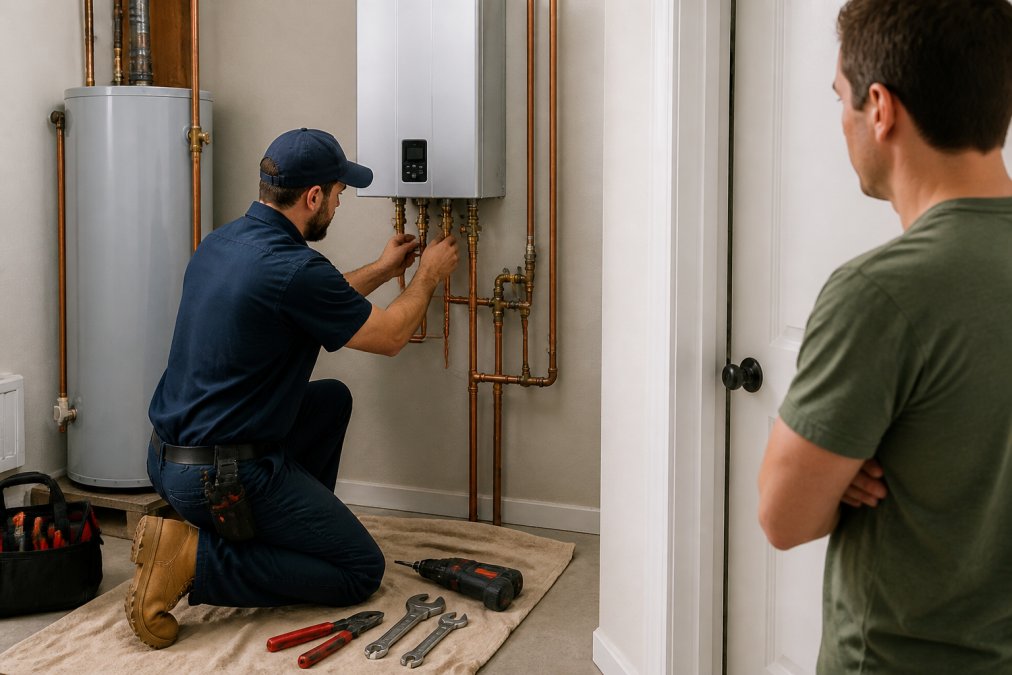
Several factors extend the timeline:
- Fuel type changes. Switching from electric to gas adds gas line installation and venting work.
- Code corrections. Older homes often need updated venting systems or a thermal expansion tank.
- Access and removal. Tight utility closets or basements slow down removal of the old unit.
- Permit inspection scheduling. The physical install may finish in hours, but inspection timing depends on your locality.
If you’re planning a residential water heater installation in Roanoke, book it before the unit fails completely. Emergency replacements on weekends and holidays cost more and leave you without hot water in the meantime.
Virginia Energy Rebates and Cost Factors for Water Heater Installation
Most quotes you see online lump everything into one number, which makes it impossible to tell whether you are paying for equipment, labor, or a markup. A more useful way to read a water heater quote is to split it into the two buckets that actually drive the total: the unit itself and the installation labor and materials. Equipment is the smaller and more predictable half; labor and any infrastructure work is where quotes diverge the most.
What Actually Drives the Total
- The unit. A standard tank costs less than a tankless or heat pump model of comparable capacity. Capacity, fuel type, and efficiency rating move the equipment price more than brand does.
- Labor. A straightforward swap in an accessible utility closet is the low end. Tight basements, second-floor closets, and haul-away of a heavy old tank push labor up.
- Infrastructure upgrades. These are the wildcard line items: a new gas line run, upgraded venting, a 200-amp electrical panel upgrade for an electric tankless unit, or a thermal expansion tank on a closed system.
- Permit and inspection fees. A real, non-negotiable line item that varies by jurisdiction and scope.
- Code corrections. Older homes frequently need updated venting or a properly piped TPR discharge before the inspector will sign off.
Because equipment prices and labor rates shift, a responsible contractor will not quote a firm number over the phone. What you should expect instead is an on-site assessment followed by upfront, itemized pricing that you authorize before any work begins, so the equipment, labor, permit, and any upgrade costs are visible as separate lines rather than buried in one figure.
Cost Breakdown by Unit Type
| Unit Type | Typical Lifespan | Key Cost Drivers | Best For |
|---|---|---|---|
| Standard gas tank | 8-12 years | Unit, venting, permit | Most households |
| Standard electric tank | 8-12 years | Unit, wiring, permit | Homes without gas |
| Tankless gas | Up to 20 years | Unit, gas line, venting | High-demand homes |
| Heat pump | 10-15 years | Unit, electrical, space | Efficiency-focused homes |
Incentives Worth Checking Before You Choose a Model
High-efficiency units can qualify for more than one incentive at once, and stacking them is where the real savings are. The programs most worth verifying before you buy:
- Federal tax credits. The federal Energy Efficient Home Improvement Credit (Section 25C) has historically covered a percentage of the cost of qualifying high-efficiency water heaters, including certain heat pump models, subject to annual caps. Confirm current eligibility and amounts with a tax professional, since the program terms and caps change.
- Utility rebates. Dominion Energy Virginia and Appalachian Power, the two utilities serving most of the Roanoke Valley, have offered rebates on qualifying heat pump water heaters and other efficiency upgrades. Rebate amounts and eligible models change, so check the current program page for your utility before you commit to a model.
- Manufacturer promotions. Brands periodically run their own rebates or promotional pricing on specific models, which can stack on top of utility and federal incentives.
- Low-income and electrification programs. Certain state and utility programs target income-qualified households or fuel-switching projects, which can cover a larger share of the cost.
Check for rebates before you choose a model, not after. Energy Star rated heat pump water heaters tend to qualify for the largest incentives, and stacking a federal tax credit with a utility rebate can meaningfully offset the upfront cost. Verify current amounts with your utility and a tax professional, since programs change and eligibility depends on your specific unit and household.
Classic Plumbing Solutions provides upfront pricing with your authorization before any work begins, so there are no surprise charges after the job starts. We also offer project financing and discounts for seniors and military families.
Water Quality and Maintenance: Protecting Your Investment
Hard water is the leading cause of premature water heater failure in many areas, and it’s the factor most homeowners overlook. Minerals in hard water settle as sediment at the tank bottom, forcing the burner or element to work harder and shortening the unit’s lifespan.
The fix is straightforward: annual preventative maintenance. Flushing the tank removes sediment buildup, and inspecting the anode rod tells you whether the tank interior is still protected from corrosion. Anode rod replacement is inexpensive and can add years to a tank’s life.
Other maintenance essentials:
- Test the temperature pressure relief valve annually to confirm it opens and reseats properly.
- Check for gas leaks on gas units during every service visit.
- Monitor water pressure regulation to keep pressure within the manufacturer’s range.
- Schedule a plumbing inspection every year, especially as the unit approaches the end of its rated lifespan.
A whole-home water softener reduces mineral load on the heater and on every other appliance connected to your plumbing. For homes with severe hard water, it’s often the single best investment in equipment longevity.
Classic Plumbing Solutions backs every job with a 3-Way Warranty covering parts, labor, and services, and our technicians are drug-tested and background-checked before they ever step into your home.
Replacing a water heater involves more than swapping one box for another: permits, code compliance, sizing, and water quality all shape how long the new unit lasts. Classic Plumbing Solutions has served the Roanoke Valley since 1980 with upfront pricing, a BBB A+ rating, and a 3-Way Warranty on parts, labor, and services, plus financing and senior and military discounts. Get started with Classic Plumbing Solutions and schedule a residential water heater installation with a team that stands behind the work.
Frequently Asked Questions
Do you need a permit to replace a water heater in Virginia?
Yes. Most jurisdictions in Virginia, including Roanoke, require a plumbing permit for water heater replacement. The permit ensures the work meets current plumbing codes, including proper venting, temperature pressure relief valve installation, and gas line or voltage requirements. A licensed contractor typically pulls the permit on your behalf and schedules the required inspection. Skipping the permit can lead to failed inspections, insurance complications, and costly corrections later. Always confirm local requirements before work begins.
What are the signs that a water heater is failing?
Common signs water heater needs replacement include rusty or discolored hot water, popping or rumbling sounds from sediment buildup, moisture or pooling around the base, and inconsistent hot water capacity. If your unit is over 10 years old and requires frequent repairs, replacement usually makes more sense than another fix. A licensed plumber can inspect the anode rod, thermal expansion tank, and temperature pressure relief valve to confirm whether repair or replacement is the better path.
How long does water heater installation take?
A standard tank water heater replacement typically takes 2 to 4 hours for a like-for-like swap. Tankless water heater installation can take 4 to 8 hours or longer, especially if gas line installation or venting systems need modification. Converting from tank to tankless, relocating the unit, or upgrading electrical voltage requirements adds time. Same-day service is often possible for straightforward replacements when the unit is in stock and no major code upgrades are needed.
How much should you pay to install a water heater?
Installation pricing depends on unit type, fuel source, venting, permit fees, and whether code upgrades are needed. A straightforward tank replacement costs less than a tankless conversion that requires new gas line installation or electrical work. Request an upfront quote that itemizes labor, parts, permit costs, and any potential code corrections. Reputable contractors provide written estimates and get customer authorization before starting work, so there are no surprise charges.
