

Table of Contents
- Does Hard Water Damage Pipes? What the Evidence Actually Shows
- Scale Buildup vs. Corrosion: Two Different Problems
- Signs of Mineral Buildup in Plumbing You Should Not Ignore
- How Hard Water Affects Copper, Steel, and PEX Pipes
- How to Remove Hard Water Buildup in Pipes
- How to Prevent Limescale in Pipes Before It Starts
- Water Softener Effects on Pipes: What Changes and What Does Not
- When to Call a Licensed Plumber
- Frequently Asked Questions
Last Updated: October 5, 2026
Does Hard Water Damage Pipes? What the Evidence Actually Shows
Hard water does not usually destroy pipes overnight, but it leaves mineral deposits that build up over years, narrowing pipes, cutting water flow, and stressing your plumbing. At Classic Plumbing Solutions, we have worked on Roanoke Valley homes since 1980, and the pattern is always the same: slow, quiet damage that is easy to miss until a fixture fails.
So, does hard water damage pipes? Rarely by itself. The real harm comes from what it leaves behind.
Hard water carries high levels of dissolved minerals, mainly calcium and magnesium.
Here is what matters most:
- Hard water itself is not corrosive to most pipes.
- The minerals in it form scale that narrows pipe diameter.
- Narrower pipes mean lower water pressure and slower drains.
That distinction between corrosion and scale changes what you should worry about and what you should do.
Below, we break down the signs of mineral buildup in plumbing, how to remove hard water buildup in pipes, and how to prevent limescale in pipes before it starts.
Scale Buildup vs. Corrosion: Two Different Problems
Scale buildup and corrosion are not the same thing, and mixing them up leads to the wrong fix.
Scale is like cholesterol in an artery: it does not damage the pipe wall, but it blocks flow.
Here is how to tell them apart:
| Problem | What Causes It | What You Notice | Pipe Damage |
|---|---|---|---|
| Scale buildup | Calcium and magnesium deposits | Reduced flow, white crust, noisy fixtures | Blockage, not structural |
| Corrosion | Water chemistry, age, metal breakdown | Discolored water, pinhole leaks, rough pipe | Structural weakening |
The U.S. Geological Survey water hardness overview explains that hardness comes from minerals picked up as water moves through soil and rock.
A common mistake is treating every slow drain as a scale problem.
Signs of Mineral Buildup in Plumbing You Should Not Ignore
The clearest signs of mineral buildup in plumbing show up at your fixtures first, since that is where scale collects fastest.
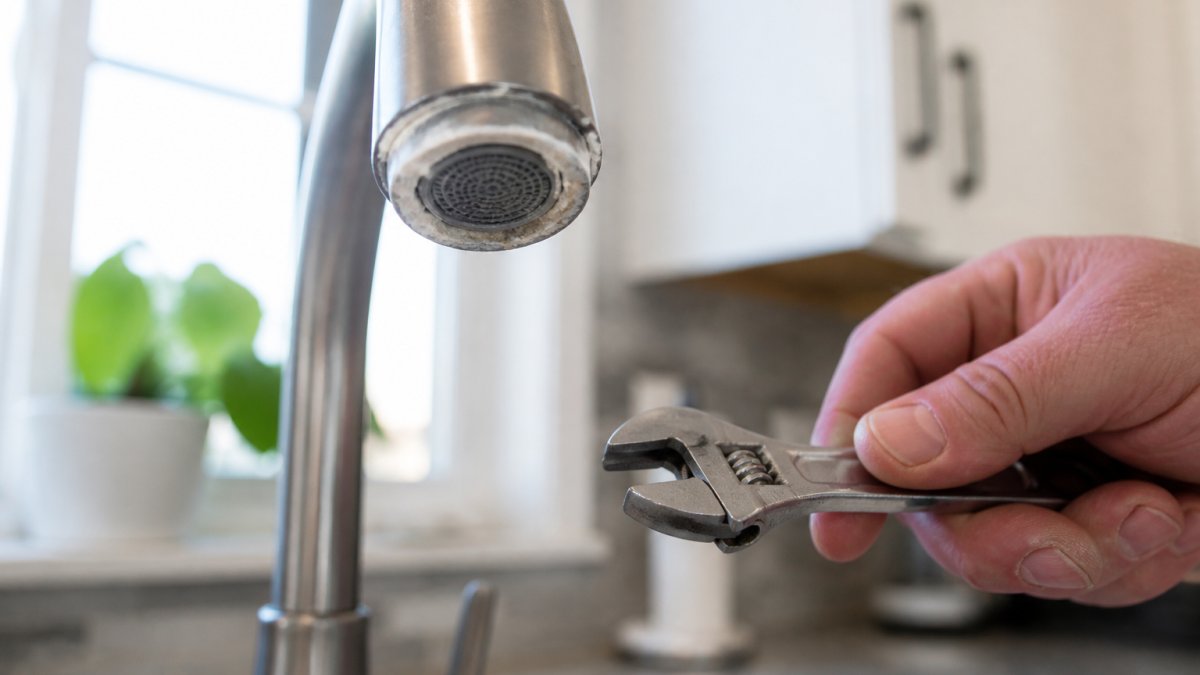
Watch for these warning signs:
- White, chalky crust on faucets and showerheads
- Water pressure that drops slowly over months
- A water heater that takes longer to heat water
If you see several of these at once, hard-water deposits are likely building up inside your plumbing. The earlier you catch them, the easier they are to clear.
How Hard Water Affects Copper, Steel, and PEX Pipes
Not every pipe material reacts to hard water the same way, and the difference comes down to two processes: scale deposition and corrosion. A material can be vulnerable to one, both, or neither, and that determines what you should watch for.
Here is how the common materials compare:
| Pipe Material | Scale Buildup | Corrosion Risk | What Typically Happens |
|---|---|---|---|
| Copper | Yes, over years | Low from hardness alone | Scale narrows the bore and stresses soldered joints; copper can still pit if water chemistry is aggressive (low pH, high chlorides) |
| Galvanized steel | Yes, often heavy | High, especially in older lines | Scale and internal rust combine; the line can choke off or leak from the inside out |
| PEX | Yes, but slower to matter | None from hardness | Flexible plastic does not corrode; scale can still collect, particularly near fittings and hot-water runs |
| PVC / CPVC | Yes, but usually minor | None from hardness | Smooth plastic walls resist deposit adhesion better than metal, though hot CPVC runs can still collect film |
A few mechanisms worth understanding:
- Scale grows where water slows and heats. Hot-water lines, water heater tanks, and the last few feet before a fixture collect deposits fastest because heat drives calcium carbonate out of solution.
- Corrosion is driven by water chemistry, not hardness. Low pH, high chloride, dissolved oxygen, and dissimilar-metal connections drive corrosion far more than calcium or magnesium do, which is why two homes on the same hard-water supply can have very different pipe outcomes.
- Galvanized steel is the outlier. In many older homes, the inside of galvanized pipe is already narrowed by scale and rust. Once flow drops noticeably, the practical fix is usually replacement of the affected run rather than cleaning.
Pipe lifespan depends on material, water chemistry, temperature, and how long buildup has been growing. A copper line in a hard-water home may last decades but will not flow like new; a galvanized line in the same home may already be near the end of its service life.
Match your concern to the material. In metal pipes, ask about both scale and corrosion. In plastic pipes, scale is the only realistic issue, and it is usually manageable with routine flushing and fixture cleaning.
If you are unsure what your home has, a plumber can identify the material at accessible points and tell you whether the priority is descaling, corrosion inspection, or replacement.
How to Remove Hard Water Buildup in Pipes
You can clear light scale at your fixtures yourself, but heavy buildup inside pipes needs a professional.
For faucets and showerheads:
- Unscrew the aerator or showerhead.
- Soak it in white vinegar for several hours or overnight.
- Scrub off the softened crust with an old toothbrush.
- Rinse and reattach.
Vinegar works because its acid breaks down calcium and magnesium deposits, and it is safe for most fixtures.
For water heaters and main lines, DIY falls short. A plumber can flush the tank, clear scale from accessible lines, and check for leaks or cracks.
Do not pour harsh chemical drain cleaners into pipes to fight scale. They are built for clogs, not mineral deposits, and they can damage older metal pipes. Vinegar and a plumber’s flush are safer.
How to Prevent Limescale in Pipes Before It Starts
Prevention starts with knowing how hard your water actually is. Symptoms alone are unreliable, since spotting and slow faucets can have other causes. Testing gives you a number you can act on.
Measure hardness before you treat it
Hardness is reported in two common units:
- Grains per gallon (gpg), the unit most water-treatment equipment is sized in.
- Milligrams per liter (mg/L), which is the same as parts per million (ppm), the unit most water-quality reports use.
To convert, 1 gpg equals about 17.1 mg/L. So water at 10 gpg is roughly 171 mg/L.
General bands used in the water-treatment industry:
| Hardness (gpg) | Hardness (mg/L) | Typical Label |
|---|---|---|
| Less than 1 | Less than 17 | Soft |
| 1 to 3.5 | 17 to 60 | Slightly hard |
| 3.5 to 7 | 60 to 120 | Moderately hard |
| 7 to 10.5 | 120 to 180 | Hard |
| More than 10.5 | More than 180 | Very hard |
You can get a number three ways:
- Check your utility’s annual water quality report. Most public systems publish hardness ranges, though they may report it as calcium carbonate (CaCO3).
- Use a home test kit. Drop-style titration kits give a gpg or mg/L reading and cost little; test strips are faster but less precise.
- Have a lab or water-treatment professional test it. Best when you are also checking iron, manganese, or pH, which affect treatment choices.
Test a cold tap and, if you can, the water feeding your water heater. Hardness is the same, but the hot side is where scale forms fastest.
Prevention steps that match your number
- Under about 3.5 gpg: Routine maintenance is usually enough. Flush the water heater annually, clean aerators and showerheads every few months, and descale fixtures that see heavy use.
- About 3.5 to 7 gpg: Consider a softener if you have a tank-style water heater, visible scale, or appliances you want to protect. Maintenance alone may still be workable.
- Above about 7 gpg: A whole-home softener is the most effective single step. It removes the calcium and magnesium before the water reaches your pipes, so scale has far less chance to form.
Treatment options and their trade-offs
Not every device does the same job:
- Ion-exchange water softeners remove calcium and magnesium and are the standard for scale prevention. They need salt and periodic maintenance, and they add a small amount of sodium to the water.
- Salt-free conditioners change how minerals behave so they are less likely to stick, but they do not remove hardness. Results vary, and they are not a substitute for a softener where scale is severe.
- Point-of-use filters treat one fixture, reducing scale at that tap but doing nothing for your water heater or the rest of the plumbing.
Skipping water heater maintenance is one of the most common and costly mistakes. Sediment builds on the tank bottom, forcing the heater to work harder and shortening its life. A yearly flush costs far less than a replacement.
Ongoing habits that keep scale down
- Flush your water heater once a year.
- Clean faucet aerators and showerheads every few months.
- Run a descaling routine on fixtures that see heavy use.
- Have a plumber inspect your plumbing system every couple of years, especially if you have galvanized steel.
A water softener is the single most effective step for a hard-water home, but it works best sized to your actual hardness number and paired with routine maintenance.
Water Softener Effects on Pipes: What Changes and What Does Not
A water softener stops new scale from forming, but it does not remove old buildup already inside your pipes, the key point homeowners miss.
What a softener does:
- Removes calcium and magnesium before water enters your pipes
- Prevents new limescale from forming
- Protects water-using appliances like the water heater and dishwasher
- Makes soap lather better and reduces soap scum
What a softener does not do:
- Strip away existing scale deposits
- Repair corrosion or cracks already present
- Restore flow in a badly clogged pipe
If your pipes already have years of buildup, a softener alone will not fix it. You may need a professional flush first, then a softener to keep the problem from coming back.
When to Call a Licensed Plumber
Call a licensed plumber when buildup has gone beyond what cleaning can fix.
Reach out if you notice:
- Water pressure that stays low even after cleaning fixtures
- Discolored or rusty water from any tap
- Leaks, cracks, or damp spots near pipes
- A water heater that rumbles or heats slowly
At Classic Plumbing Solutions, our technicians are drug-tested and background-checked, and we give upfront pricing before any work begins. We also back our repairs with a 3-Way Warranty on parts, labor, and services, plus discounts for seniors and military families.
Hard water damage is slow, but it is not invisible. Watch your fixtures, flush your water heater, and treat the water before scale takes hold. Catching it early keeps your pipes flowing for years to come.
Frequently Asked Questions
Can hard water clog or damage pipes?
Hard water does not usually destroy pipes outright, but it leaves calcium and magnesium deposits that narrow the inside diameter over time. That narrowing reduces flow and raises pressure on joints and fittings. In homes with very hard water, scale can build up for years before a homeowner notices slower drains or lower water pressure. The damage is gradual rather than sudden, which is why annual checks on older plumbing help catch buildup early.
Can hard water corrode copper pipes?
Hard water by itself is not the main cause of copper corrosion. The bigger factors are water chemistry, pH, and dissolved oxygen. However, heavy scale on copper can trap moisture and create conditions where pitting corrosion starts. If you see blue-green stains near fittings or a metallic taste in the water, that points to corrosion rather than plain scale. A licensed plumber can test the water and inspect the pipe interior to confirm which problem you have.
Do water softeners ruin pipes?
No. A properly sized and installed water softener removes the calcium and magnesium that form scale, which helps protect pipes and appliances. Problems come from poor installation, oversized units, or using the wrong salt setting. Softened water can be slightly more aggressive to old metal pipes that already have corrosion, so it is wise to have a plumber inspect aging plumbing before adding a softener. Regular maintenance keeps the system working as intended.
How do you get rid of hard water buildup in pipes?
For light buildup, soaking removable fixtures like faucet aerators and showerheads in white vinegar overnight loosens mineral crust. Whole-pipe descaling is harder because the scale sits on the inside of the pipe. A plumber can flush the system or, in severe cases, replace badly narrowed sections. If water pressure has dropped noticeably at every fixture, the buildup is likely too thick for a homeowner-level fix, and a professional inspection is the safer next step.
