

Table of Contents
- Best High Efficiency Water Heaters 2026: Our Top Picks
- Tankless vs Tank Water Heater Efficiency: Which Wins?
- Heat Pump Water Heaters: The Efficiency Leader
- How to Tell if Water Heater Needs Replacement or Upgrade
- Heat Pump Water Heater Tax Credits 2026: What You Save
- Sizing and Installation: Matching the Unit to Your Home
- Smart Features and Retrofitting Considerations
- Conclusion: Making the Switch in 2026
- Frequently Asked Questions
Last Updated: September 7, 2026
Best High Efficiency Water Heaters 2026: Our Top Picks
Choosing the best high efficiency water heaters 2026 has to offer starts with understanding that “efficiency” means different things depending on your home’s setup. The most efficient unit matches your fuel source, space, and usage patterns, not the one with the highest sticker price.
Classic Plumbing Solutions has served the Roanoke Valley since 1980. This guide shows which technology saves money over its lifespan, what the 2026 tax credits cover, and the installation realities most guides skip.
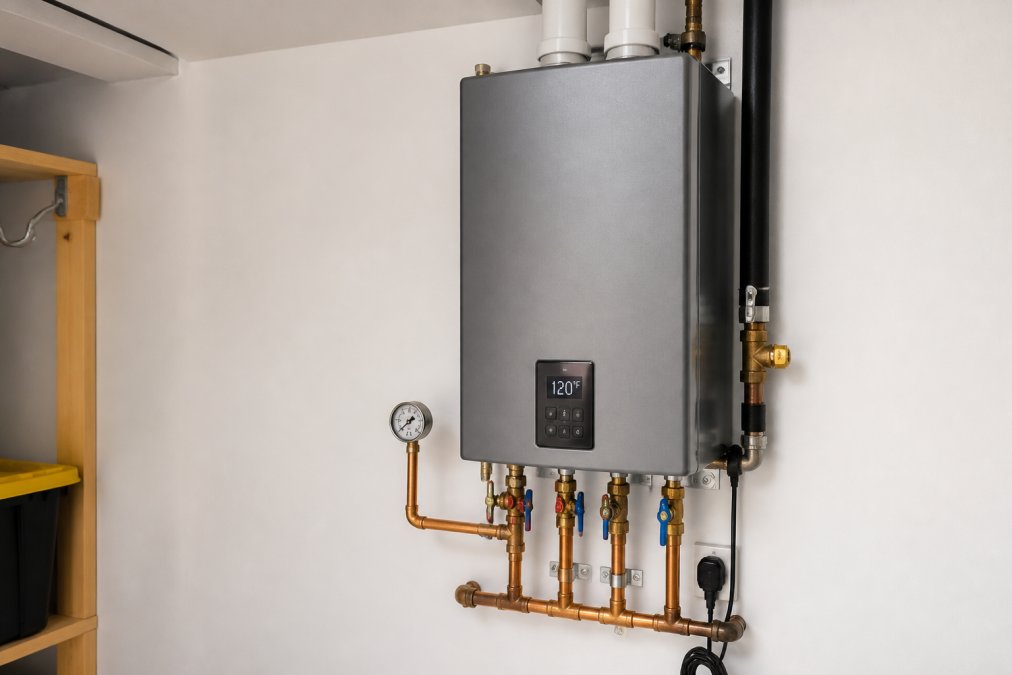
How We Evaluated These Models
We scored units across five criteria: Uniform Energy Factor (UEF), first-hour rating, installation complexity, estimated annual operating cost, and long-term maintenance demands. A high efficiency water heater that saves energy but requires venting you cannot install is not a good pick for your home. We weighed real-world retrofitting challenges as heavily as theoretical efficiency numbers, since the U.S. Department of Energy’s appliance standards set the baseline UEF ratings that determine which units qualify for rebates.
The most efficient water heater on paper is only the best choice if it fits your space, fuel source, and budget. Match the technology to your home, not the other way around.
Tankless vs Tank Water Heater Efficiency: Which Wins?
Tankless vs tank water heater efficiency is not a simple one-number comparison. A typical high-efficiency condensing tankless unit carries a UEF of 0.95 to 0.98, while a high-efficiency tank model with a heat pump (hybrid) tops out around 3.5 UEF. But a standard gas tank with a UEF of 0.67 can still cost less to operate than a tankless unit if your household uses less than 40 gallons per day.
The Standby Loss Reality
A 50-gallon tank keeps water hot 24/7, losing 0.5 to 1.0 percent of its stored heat per hour. Tankless units eliminate that loss, but introduce the cold-water sandwich effect: turn the hot water off and back on within a few minutes, and the unit purges cooled water in the heat exchanger before delivering hot water again, wasting a small amount of water and energy per cycle.
Flow Rate and Recovery: The Real Trade-Off
Tankless units deliver a continuous flow of hot water, but only up to their rated GPM. A typical condensing tankless unit provides 5.5 to 8.0 GPM at a 70-degree temperature rise. Run a 2.5 GPM shower, a 1.5 GPM dishwasher, and a 1.5 GPM laundry faucet simultaneously, and you are pulling 5.5 GPM, right at the limit for many units. Exceed it, and the outgoing temperature drops. A tank model delivers its full first-hour rating, typically 60 to 80 gallons for a 50-gallon high-efficiency unit, before it needs to recover.
Cost Comparison Over 10 Years
For a family of four using 60 gallons per day, a 50-gallon high-efficiency gas tank (UEF 0.68, $1,200 installed) costs about $320 per year to operate, while a condensing tankless unit (UEF 0.95, $2,800 installed) costs about $230 per year. The tankless saves $90 per year but costs $1,600 more upfront, with a break-even point of roughly 18 years, exceeding the typical 15-year lifespan of a tankless unit. For an electric home, a heat pump tank (UEF 3.5, $2,500 installed) costs about $180 per year at $0.16 per kWh, while a condensing tankless electric unit (UEF 0.95, $1,800 installed) costs about $650 per year. The heat pump tank pays back its premium in under two years.
For gas homes, a high-efficiency tank is often the better value unless you have very high hot water demand. For electric homes, a heat pump tank beats both tankless and standard electric tanks on operating cost by a wide margin.
Maintenance and Lifespan Differences
Tankless units require descaling every 12 to 18 months in hard-water areas, running $150 to $300 per visit. Tanks require annual flushing and anode rod inspection, costing $100 to $200 per year. Tankless units typically last 20 years or more, while tanks last 10 to 15 years.
When Tankless Actually Wins
Tankless units make sense in three specific scenarios: (1) homes with limited floor space where a 50-gallon tank does not fit, (2) households with very high continuous demand, and (3) homes where you are already upgrading the gas line and venting for other appliances. For everyone else, a high-efficiency tank or heat pump tank delivers better return on investment.
Do not choose a tankless unit without calculating your peak simultaneous demand and your local gas or electric rates. The efficiency rating alone does not determine your annual operating cost. Run the numbers for your household before committing.
Heat Pump Water Heaters: The Efficiency Leader
Heat pump water heaters (HPWHs), also called hybrid water heaters, are the efficiency leaders in 2026. Instead of generating heat directly, they use a refrigeration cycle to extract heat from the surrounding air and transfer it to the water. A typical HPWH has a UEF of 3.0 to 3.5, translating to an estimated annual operating cost of $150 to $250 for a family of four, compared to $500 to $700 for a standard electric resistance tank.
The Refrigeration Cycle, Explained
An HPWH works like an air conditioner in reverse. A fan draws warm air across an evaporator coil containing refrigerant, which absorbs heat and evaporates into a gas. A compressor raises the pressure and temperature of that gas, then pushes it through a condenser coil wrapped around the water tank, releasing heat into the water. This cycle runs until the water reaches the set temperature, typically 120 to 140 degrees Fahrenheit.
Installation Requirements Most Guides Skip
An HPWH is not a drop-in replacement for a standard electric tank. It requires:
- Air volume: At least 1,000 cubic feet of surrounding air, roughly a 10-by-10-by-10-foot space. In a small closet, the unit will quickly cool the air and drop its efficiency.
- Condensate drain: The dehumidification process produces 1 to 2 gallons of condensate per day. You need a floor drain or a condensate pump to route the water to a nearby drain.
- Dedicated 240-volt circuit: Most HPWHs require a 30-amp circuit. If your existing electric tank uses a 30-amp breaker, the wiring may be sufficient, but you must verify the wire gauge and breaker size match the manufacturer’s specifications.
- Minimum ambient temperature: Most units operate down to 40 degrees Fahrenheit. Below that, the compressor may shut off and the unit switches to electric resistance mode, which defeats the efficiency advantage. In an unheated garage in a cold climate, an HPWH will run in resistance mode for much of the winter.
- Noise: The compressor and fan produce 45 to 55 decibels, comparable to a refrigerator. If the unit is near a bedroom or living area, that hum may be noticeable.
Climate Performance Data
The efficiency of an HPWH depends heavily on the temperature and humidity of the surrounding air. In a warm basement or utility room, the unit performs at or above its rated UEF. In a cooler space, such as an unheated garage in the northern United States, efficiency drops by 20 to 30 percent. In a hot, humid climate like the Southeast, an HPWH helps dehumidify the space, reducing the load on your air conditioner.
Retrofitting from Gas to Heat Pump: The Hidden Costs
Switching from a gas tank to an electric HPWH is not just swapping the appliance. You must account for:
- Gas line abandonment: You cannot simply cap the gas line and leave it. A licensed plumber must properly cap the line at the appliance and at the manifold, and you may need to notify your gas utility. This costs $150 to $300.
- Electrical upgrade: If your home has a 100-amp electrical panel, adding a 30-amp circuit for an HPWH may overload the panel. A panel upgrade to 200-amp service runs $1,500 to $3,000.
- Venting removal: The existing gas vent pipe must be removed or sealed, which is an additional cost.
- Space reconfiguration: An HPWH is typically taller and wider than a standard tank. A 50-gallon HPWH measures roughly 60 to 66 inches tall and 24 to 26 inches in diameter. Measure your alcove carefully.
The total retrofitting cost to switch from gas to an electric HPWH can add $2,000 to $4,000 beyond the unit price. Factor this into your payback calculation. The federal tax credit and utility rebates help, but they may not cover the full infrastructure cost.
Hybrid Mode and Recovery Time
Most HPWHs offer multiple operating modes: heat pump only, electric resistance only, and hybrid. Hybrid mode uses the heat pump as the primary heat source and switches to electric resistance elements when demand spikes, ensuring you never run out of hot water, but drawing 4,500 to 5,500 watts during resistance mode. Recovery time for a 50-gallon HPWH in heat pump mode is 60 to 90 minutes, compared to 20 to 30 minutes for a gas tank.
The Carbon Footprint Angle
For eco-conscious buyers, an HPWH is the clear winner. A typical electric resistance water heater emits about 2.5 tons of carbon dioxide per year, while an HPWH, at one-third the energy consumption, emits about 0.8 tons per year. That is a reduction of 1.7 tons annually, equivalent to taking a passenger vehicle off the road for four months.
An HPWH is the right choice if you have adequate air volume, a condensate drain, a suitable electrical circuit, and ambient temperatures above 50 degrees Fahrenheit for most of the year. If you are missing any of those, the installation cost and efficiency penalty may make a high-efficiency gas tank or a condensing tankless unit a better fit.
How to Tell if Water Heater Needs Replacement or Upgrade
Knowing how to tell if water heater needs replacement versus a simple repair saves you from both an unnecessary expense and a cold shower. Most tank-style water heaters last 10 to 15 years with regular maintenance. If yours is past the 12-year mark, replacement is usually more cost-effective than repairing a failing component.
Rust-colored water from the hot tap, rumbling or popping noises from the tank, and visible corrosion on the tank body are all signs the unit is failing. A rumbling sound indicates scale buildup at the bottom of the tank, which forces the burner to work harder and reduces thermal efficiency.
A leaking tank is not a repair situation. Once the inner tank begins leaking, it cannot be welded or patched. Continuing to run a leaking unit risks water damage to your floors and walls. Budget for replacement immediately.
Annual maintenance, including flushing the tank and checking the anode rod, extends the life of any water heater. The anode rod sacrifices itself to prevent corrosion inside the tank. Replacing it every three to five years is inexpensive and can add years to the unit’s life.
Heat Pump Water Heater Tax Credits 2026: What You Save
The heat pump water heater tax credits 2026 landscape is more favorable than ever. Under the Inflation Reduction Act, homeowners can claim a federal tax credit for installing an energy-efficient heat pump water heater that meets specific UEF requirements, covering a portion of the purchase and installation costs, subject to an annual cap.
The 2026 federal tax credit applies only to heat pump water heaters, not to tankless or high-efficiency tank models. If your goal is maximum savings on the purchase, a heat pump unit is the only technology that qualifies for this specific credit.
Many utility companies and state energy offices offer additional rebates on top of the federal credit. The Database of State Incentives for Renewables and Efficiency maintains a searchable list of available incentives by zip code. Combining a federal credit with a local utility rebate can reduce the effective cost of a heat pump water heater significantly, making it competitive with a standard electric tank.
To qualify, the unit must have a UEF rating above the threshold set by the federal government. Check the manufacturer’s specifications before purchasing, and keep all receipts and the ENERGY STAR certification for your tax records.
Sizing and Installation: Matching the Unit to Your Home
Sizing a high efficiency water heater correctly prevents both wasted energy and disappointed family members. The key metric is the first-hour rating, which tells you how much hot water the unit can deliver in the first hour of heavy use. Match the first-hour rating to your peak demand.
A common approach is to estimate 10 to 15 gallons per person for a tank-style unit. A family of four typically needs a 50-gallon tank, while a family of six should step up to 65 or 80 gallons. For tankless units, calculate your peak GPM demand by adding up the flow rates of fixtures you might run simultaneously.
Venting requirements differ by technology. Gas-fired tankless and condensing tankless units require proper venting to exhaust combustion gases. Heat pump water heaters need no venting but require adequate air volume. Electric resistance models are the simplest to install, needing only a 240-volt circuit.
Retrofitting a tankless unit often requires upgrading your gas line and venting system. These costs add up quickly. Get a quote that includes all modifications before committing to the purchase, so the final price does not surprise you.
Smart Features and Retrofitting Considerations
Modern high efficiency water heaters increasingly include smart home integration. Wi-Fi-enabled units let you monitor energy consumption, set temperature schedules, and receive leak alerts from your phone.
These features add convenience, but they also add cost and complexity. A smart water heater is only worth the premium if you will actually use the scheduling and monitoring features.
Retrofitting considerations often determine which unit is realistic for your home. A heat pump water heater requires adequate air volume and a condensate drain. A tankless unit may require a larger gas line and new venting. An electric heat pump model needs a dedicated circuit. Measure your space and check your utility connections before shopping. The ENERGY STAR water heater product finder lets you filter by fuel type, tank size, and efficiency to narrow your options.
The best high efficiency water heaters 2026 models share one trait: they match the home’s infrastructure. A unit that requires extensive retrofitting loses its cost advantage in installation fees.
Conclusion: Making the Switch in 2026
The decision to upgrade your water heater is a balance of upfront cost, annual operating cost, and the logistics of installation. Heat pump models lead in efficiency and qualify for the heat pump water heater tax credits 2026, but they require specific installation conditions. Tankless units eliminate standby loss and offer endless hot water, but they demand careful sizing and potentially costly venting upgrades.
If you are unsure whether your current unit needs replacement or an upgrade, a professional inspection provides clarity. Classic Plumbing Solutions has served the Roanoke Valley since 1980 with A+ BBB accreditation, drug-tested and background-checked technicians, and honest upfront pricing. We offer high thermal efficiency water heater options, a 3-Way Warranty on parts, labor, and services, and special discounts for seniors and military families.
Get started with Classic Plumbing Solutions and find the right high efficiency water heater for your home. Tap to call now for a consultation and upfront quote.
Frequently Asked Questions
What is the most energy-efficient type of water heater available in 2026?
Heat pump water heaters, also known as hybrid models, are the most energy-efficient type for most homes in 2026. They use electricity to move heat from the surrounding air into the tank, rather than generating heat directly. This makes them 2-3 times more efficient than standard electric resistance models. Their high Uniform Energy Factor (UEF) ratings mean significantly lower annual operating costs. While the upfront price is higher, federal tax credits and utility rebates can offset the initial investment, making them a strong long-term choice.
Is AO Smith or Rheem better for high efficiency models?
Both AO Smith and Rheem manufacture excellent high-efficiency water heaters, including top-tier heat pump and condensing tankless models. Rheem is often recognized for its innovative integrated heat pump designs and smart home connectivity. AO Smith is known for its durable construction and reliable performance. For the best results, focus on the specific UEF rating and warranty of the model you are considering rather than the brand alone. A licensed plumber can help you choose the unit that best fits your home’s needs and budget.
Do heat pump water heaters qualify for tax credits in 2026?
Yes, heat pump water heaters can qualify for a federal tax credit in 2026. The Inflation Reduction Act extended a credit for qualifying energy-efficient home improvements. To receive the credit, the unit must meet specific Uniform Energy Factor (UEF) requirements and be installed in your primary residence. The credit covers a portion of the purchase cost, up to a set annual limit. Check the official ENERGY STAR website for the latest requirements and consult a tax professional to confirm your eligibility.
How do I know if my current water heater is energy efficient?
Check the yellow EnergyGuide label on your water heater for its Uniform Energy Factor (UEF) rating. A UEF of 0.90 or higher is considered efficient for standard tank models, while heat pump units often rate above 3.0. If your heater is more than 10-12 years old, it likely has a lower efficiency rating than modern models. If you notice higher utility bills, slower recovery times, or rust-colored water, these are signs it may be time for a replacement with a high-efficiency model.
