

Table of Contents
- Why Plumbing Costs Hit Seniors Harder (And What to Do)
- Plumbing Financing Options for Seniors
- How to Find Honest Plumbers
- Preventative Plumbing Maintenance for Seniors
- Emergency Plumbing Repair for Seniors: What to Expect
- How to Save Money on Affordable Plumbing Repair for Seniors
- What Matters Most
- Frequently Asked Questions
Last Updated: September 25, 2026
Why Plumbing Costs Hit Seniors Harder (And What to Do)
Affordable plumbing repair for seniors starts with why the math gets so tight: a dripping faucet or failing water heater can become a financial crisis on a fixed income. This guide from Classic Plumbing Solutions covers financing, discounts, and when to call a pro.
The problem usually isn’t the repair. It’s the surprise.
The Fixed-Income Problem
Most household budgets have slack. A fixed-income budget often doesn’t. Social Security and pension payments arrive on a schedule, and an unexpected repair competes with groceries, medication, and utilities.
What You Can Control
You can’t control when a pipe fails, only who you call and what you agree to before work begins.
- Get upfront pricing in writing before any technician touches a pipe
- Ask about senior discounts before the appointment, not after
- Request project financing if the repair is large
- Get a second opinion on any repair that feels expensive
- Keep a maintenance schedule so small issues don’t become emergencies
The single biggest protection against a plumbing crisis is refusing to authorize work without a written, upfront price. A reputable contractor will always provide one.
Plumbing Financing Options for Seniors
Plumbing financing options for seniors range from in-house payment plans to government assistance programs, depending on the repair size and your income. Commercial financing and public aid are separated below because their application paths and eligibility rules differ.
Payment Plans and Project Financing
Many plumbing companies offer project financing so a large repair isn’t paid in one lump sum. This spreads the cost over months, which matters when your income arrives on a fixed schedule.
Ask these questions before signing anything:
- What’s the interest rate, if any?
- How many months is the term?
- Are there penalties for early payoff?
- Does the plan cover parts and labor, or just one?
- Is the financing through the plumbing company or a third-party lender?
Government and Non-Profit Assistance Programs
Public aid for home repairs is real but fragmented across federal, state, and local agencies, each with its own income limits, property requirements, and waitlists. Work from the largest programs down.
Call your local Area Agency on Aging before you call a plumber. They often know about repair grants and programs that aren’t advertised anywhere online. Have your most recent tax return and proof of homeownership ready, nearly every program requires both.
How to Sequence These Options
A pattern that works well: get a written estimate from a licensed plumber first, then take it to the assistance programs. Most grant and loan programs require a documented scope of work and a contractor bid before reviewing your application, so applying without an estimate usually just delays things.
How to Find Honest Plumbers
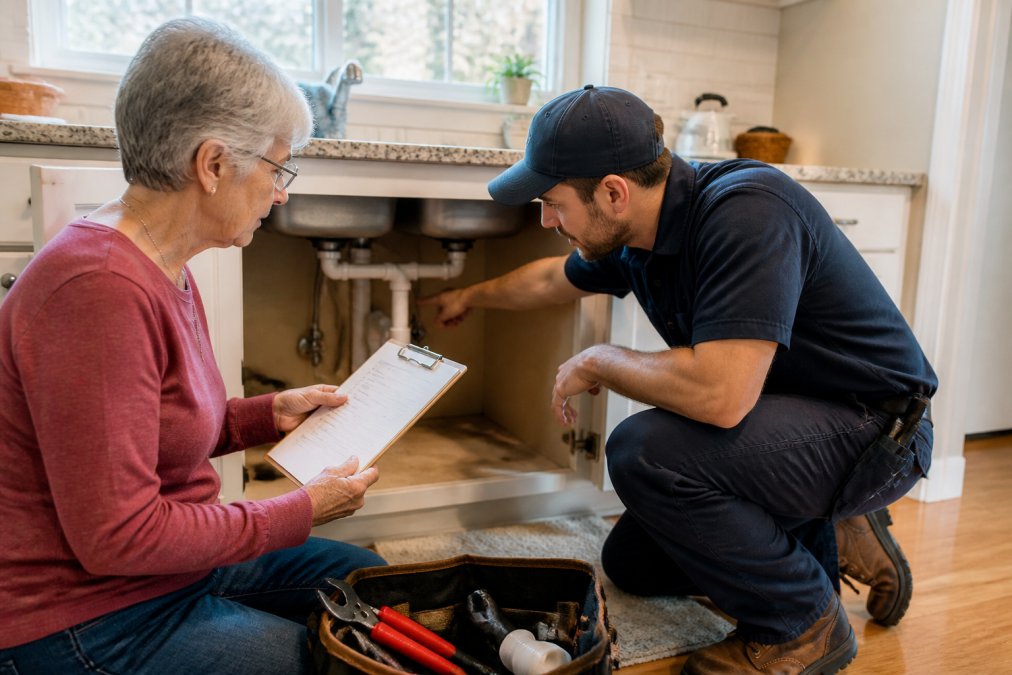
Finding honest plumbers comes down to three checks: licensing, insurance, and background screening. Skip any one and you’re gambling with your money and your home’s safety.
Licensing, Insurance, and Background Checks
A licensed plumber has met state requirements for training and code knowledge, giving you recourse if something goes wrong.
Red Flags and Vetting Scams Targeting Seniors
Scams targeting seniors often follow a pattern. Someone shows up unannounced, claims to have spotted a problem, and pressures you into an immediate decision.
Watch for these warning signs:
- No written estimate before work begins
- Pressure to decide right now or lose a “today only” price
- Cash-only payment demands with no receipt
- No license number on the truck or paperwork
- Unsolicited door-to-door offers for “free inspections”
Preventative Plumbing Maintenance for Seniors
Preventative plumbing maintenance is the cheapest repair you’ll ever make, preventing the emergencies that drain savings. This section covers where the DIY line falls and which upgrades make a home safer as you age.
DIY vs. Professional Repair Thresholds
Some jobs are safe to handle yourself; others need a licensed plumber for safety and code compliance. The dividing line isn’t difficulty, it’s risk. If a mistake can cause a gas leak, electrical hazard, water damage behind a wall, or a code violation that surfaces at resale, it belongs to a professional.
| Task | DIY or Pro? | Why |
|---|---|---|
| Tightening a loose faucet handle | DIY | Simple, low risk |
| Replacing a showerhead | DIY | No water line work |
| Replacing a faucet aerator | DIY | Hand-tightened, no tools required |
| Clearing a slow drain with a plunger or drain snake | DIY with care | Avoid harsh chemical drain cleaners |
| Replacing a toilet flapper | DIY | Inexpensive part, no water line work |
| Re-caulking a tub or shower | DIY | Prevents water intrusion behind the wall |
| Replacing a supply line under a sink | Pro | A failed connection floods the cabinet and floor |
| Water heater repair or replacement | Professional | Gas and electrical risk, plus permit requirements |
| Sewer line issues | Professional | Requires specialized camera and jetting equipment |
| Pipe replacement inside a wall | Professional | Code and permit requirements |
| Any work on the main water shutoff | Professional | A mistake here can flood the whole house |
A few thresholds worth memorizing:
- Water where it shouldn’t be. Any leak you can’t see the source of is a professional call. Water travels along joists and pipes, so the visible drip is often far from the actual failure.
- Anything behind a wall or under a slab. Opening drywall or concrete to reach a pipe is a licensed job, both because of the repair itself and because of the permit that usually accompanies it.
- Gas appliances. Never DIY anything connected to a gas line. This includes water heaters, ranges, and dryers. A mistake here is a carbon monoxide or explosion risk.
- Repeated problems. If you’ve cleared the same drain three times in a year, the clog isn’t the problem, the pipe is. That’s a camera inspection, not another bottle of drain cleaner.
- Chemical drain cleaners. These are worth avoiding entirely. They corrode older pipes, they’re dangerous to store and use, and they rarely fix the underlying blockage. A plunger or a hand snake handles most household clogs safely.
If you’re unsure whether a job is DIY or professional, it’s professional. The cost of a service call is almost always less than the cost of water damage, a gas leak, or a failed inspection.
Senior-Specific Plumbing Safety Modifications
Aging in place often means modifying your home so it stays safe. Several plumbing changes help, and most are inexpensive relative to a renovation.
- Anti-scald valves prevent burns from sudden temperature swings. They’re required by code in new construction in many jurisdictions and can be retrofitted to an existing shower or tub. This matters because older skin burns faster and at lower temperatures than younger skin.
- Lever-style faucet handles are easier to grip than knobs, and they can be operated with a closed fist or an elbow, useful if grip strength or arthritis is a factor.
- Touchless or motion-sensor faucets eliminate the need to turn a handle at all, which reduces both strain and the risk of leaving water running.
- Raised toilet seats reduce strain and fall risk. A comfort-height toilet, roughly two inches taller than a standard model, is a permanent version of the same idea.
- Grab bars near tubs and showers support safe movement. They should be anchored into studs or blocking, not just drywall, so this is a job to have done properly.
- Good lighting near sinks prevents accidents during nighttime use. A motion-sensor night light under the bathroom vanity is a small, cheap addition with a real safety payoff.
- A water alarm near the water heater and washing machine won’t prevent a leak, but it will tell you about one before it becomes a flooded floor. These are inexpensive and require no wiring.
Emergency Plumbing Repair for Seniors: What to Expect
Emergency plumbing repair for seniors should include same-day availability, upfront pricing, and a clear process. Knowing what to expect removes the panic from a burst pipe or failed water heater.
Same-Day Appointments and Upfront Pricing
A same-day appointment means the problem gets addressed before it causes water damage. Ask any company directly how fast they can respond, especially on weekends and holidays.
Never let a technician start work without a signed, written estimate. If extra problems appear mid-job, you should be asked to approve the added cost before it happens, not after.
Getting a Second Opinion on Expensive Repairs
A second opinion costs nothing but time and can save hundreds, especially for water heater replacement, sewer line work, and any repair quoted above what you expected.
How to Save Money on Affordable Plumbing Repair for Seniors
Affordable plumbing repair for seniors comes down to three levers: discounts, guarantees, and choosing cost-effective solutions over the most expensive option.
Senior Discounts and Service Guarantees
Many plumbing companies offer senior discounts and military discounts. Classic Plumbing Solutions offers both, plus a 3-Way Warranty covering parts, labor, and services.
Cost-Effective Solutions for Common Repairs
Not every problem needs the most expensive fix. Sometimes a repair beats a replacement.
- Leak detection before replacement saves money when the pipe itself is sound
- Drain cleaning often solves recurring clogs without pipe work
- Fixture installation of efficient models lowers water bills over time
- Preventative maintenance catches small issues before they become emergencies
Ask whether a repair is possible before agreeing to a full replacement. A good plumber will tell you honestly when repair makes more sense.
What Matters Most
Plumbing costs hit seniors harder because fixed incomes leave little room for surprises. The defense is straightforward: insist on upfront pricing, verify licensing and insurance, ask about senior discounts and financing, and get a second opinion on any repair that feels expensive.
Frequently Asked Questions
How can I save money on plumbing repairs?
Start by getting written estimates from at least three licensed plumbers. Ask about senior discounts, which many companies offer. For larger jobs, ask about payment plans or project financing. Preventative maintenance, like fixing slow drains early, avoids bigger bills later. Government and non-profit programs may also help low-income seniors cover urgent repairs.
Are there government grants for home plumbing repairs for seniors?
Yes, some programs exist. The U.S. Department of Housing and Urban Development (HUD) offers grants through local agencies for home repairs, including plumbing. Area Agencies on Aging and community action programs may also provide assistance. Eligibility depends on income and location. Contact your local agency to ask about available funds for affordable plumbing repair for seniors.
Do plumbing companies offer senior discounts?
Many do. Classic Plumbing Solutions, for example, offers special discounts for seniors and military families. When you call, ask directly about senior rates before booking. Some companies also waive service call fees or offer reduced labor rates for older customers. It never hurts to ask, and it can save you money on your plumbing repair.
What should seniors look for when hiring a plumber?
Look for a licensed, insured plumber with a verifiable business address and a good reputation. Ask for upfront pricing before work begins. Confirm that technicians are background-checked and drug-tested for safety. Check for a written warranty on parts and labor. Avoid anyone who demands full payment upfront or pressures you to decide immediately.
