

Table of Contents
- How Long Do Water Softeners Last: Typical Lifespan by System Type
- Key Factors That Affect Water Softener Lifespan
- Signs a Water Softener Needs Replacement
- Water Softener Maintenance to Extend System Life
- Water Softener Repair or Replacement: Making the Right Choice
- Understanding Water Softener Replacement Cost
- Conclusion
- Frequently Asked Questions
Last Updated: October 15, 2026
How Long Do Water Softeners Last: Typical Lifespan by System Type
How long do water softeners last depends largely on the system type. Most residential water softeners last 10 to 15 years with proper maintenance, though some exceed 20 years, the variation comes down to system design, water quality, and maintenance consistency.
Salt-Based Systems
Salt-based water softeners, also called ion exchange systems, are the most common type installed in homes.
The resin bed is the heart of the system. Beads degrade over time, and most beds need replacement every 5 to 10 years depending on hardness and usage.
The brine tank typically lasts the full lifespan of the system if made from quality plastic or stainless steel.
Salt-Free Water Conditioners
Salt-free systems, also called water conditioners or template-assisted crystallization systems, alter the crystal structure so minerals don’t stick to pipes and fixtures instead of removing them.
Because salt-free systems don’t use resin or require regeneration, they have fewer mechanical components to wear out.
The trade-off: salt-free systems don’t actually soften water the way ion exchange systems do, they prevent scale buildup instead.
Key Factors That Affect Water Softener Lifespan
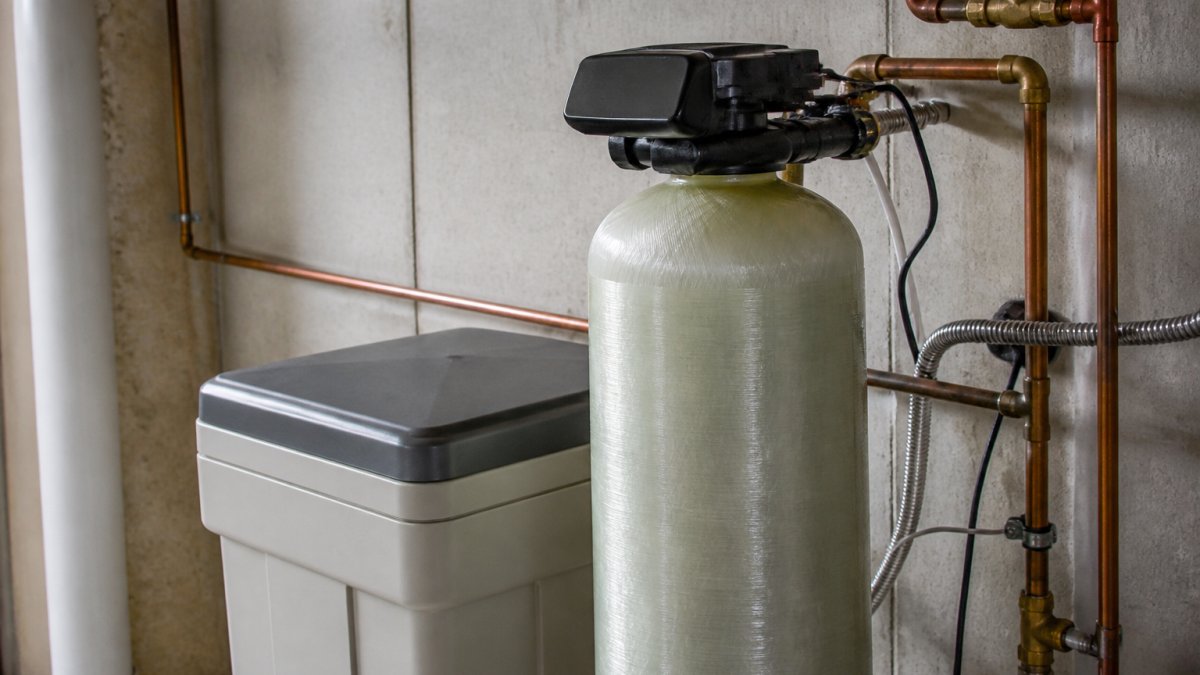
Water quality, household usage, installation quality, and maintenance habits determine whether your softener reaches 10 years or exceeds 20.
Water Quality and Hardness Levels
Water hardness is one of the biggest factors affecting lifespan. Harder water means the resin bed works harder and regenerates more frequently.
Water quality also includes sediment and iron. High iron clogs resin beads, and sediment buildup requires more frequent backwashing and accelerates wear, so well water with significant iron or municipal water with high sediment ages a system faster than average.
Household Usage and System Capacity
Household water use directly impacts wear. A family of four using 80 gallons per person daily cycles regeneration more often than one using 50 gallons, and each cycle stresses the control valve and brine tank.
An undersized system regenerates constantly and fails prematurely; one matched to peak usage reduces regeneration frequency and lasts longer.
Installation Quality and Environmental Conditions
Poor installation, incorrect plumbing connections, inadequate bypass valves, or improper drainage, causes premature failure. Systems installed by certified technicians typically last longer.
Environmental conditions matter. Basements with temperature swings, high humidity, or freezing can damage plastic components and accelerate corrosion, and direct sunlight degrades plastic tanks.
Water temperature plays a role too: dramatic fluctuations or very hot incoming water age components faster.
Signs a Water Softener Needs Replacement
Hard water returning despite the system running normally is the most obvious sign.
Visible salt bridging, a hard crust that prevents proper brine formation, means the system isn’t regenerating correctly.
Slow water flow from taps suggests sediment accumulation or resin bed deterioration. If flow decreases noticeably, internal components are likely clogged or failing.
Leaking from the tank, control valve, or brine tank connections means seals have failed. Small leaks can sometimes be repaired, but persistent leaking indicates end of life.
Grinding, squealing, or loud hissing during regeneration suggests mechanical failure inside the control valve or media tank, typically weeks or months before complete failure.
Water Softener Maintenance to Extend System Life
Proper maintenance is the single most important factor in extending your water softener’s lifespan.
Clean the brine tank annually.
Test water hardness annually or when you notice changes.
Schedule professional servicing every two to three years. Technicians inspect internal components, check control valve function, and catch problems before they cause failure.
Avoid additives marketed to “enhance” regeneration, they often damage resin beads or clog the system. Stick with quality salt and regular maintenance.
Water Softener Repair or Replacement: Making the Right Choice
Most guides answer this with a single rule of thumb, repair if the fix costs less than half a new unit, replace if it costs more. That breaks down fast: a $400 control-valve swap on a 12-year-old softener with healthy resin is a very different decision than a $900 resin replacement on the same unit. The right call depends on which component failed, how old the rest of the system is, and how many service years the repair buys.
Start with component-level diagnosis
Water softeners fail one part at a time, and each part has its own service life and repair economics. Before pricing anything, identify what actually broke.
- Resin bed. The ion-exchange resin is the working media. Under moderate hardness it lasts 10 to 15 years; under very hard water, high iron, or heavy chlorine it can degrade in 5 to 8. Symptoms: hardness creeping back, rising salt consumption, short regeneration cycles that no longer restore soft water. Resin replacement on an older unit often costs a meaningful fraction of a new softener.
- Control valve / timer / electronics. The valve head runs every regeneration cycle, accumulating the most mechanical wear. Valves commonly outlast the resin, but seals, pistons, and circuit boards fail. A valve rebuild or head replacement is usually the cheapest meaningful repair and can add 5 to 10 years to a system whose tank and resin are sound.
- Brine tank and brine valve. Plastic brine tanks rarely fail first. The brine valve, float, and safety shutoff are the wear items, a stuck float causes overfilling or salt bridging, and the fix is inexpensive.
Before you accept a “needs replacement” diagnosis, ask the technician which component failed and what the repair would cost on its own. A quote that jumps straight to replacement without a component-level explanation is worth a second opinion.
The repair-versus-replace decision framework
Once you know the failed component, weigh four things:
- Age of the system. Under 8 years, repair almost always wins unless the tank is compromised. Between 8 and 15 years, it hinges on which part failed. Past 15 years, replacement usually makes more sense even when repair is possible, because remaining components are near the end of their service lives.
- Repair cost relative to a new unit. A common guideline: repair when the quote is roughly one-third or less of a comparable new softener installed, replace when it approaches half. Treat these as starting points, a $250 valve rebuild on a 10-year-old unit with good resin is a clear repair; a $700 resin replacement on a 14-year-old unit with an aging valve is usually a replace.
- Remaining service life after the repair. A repair that buys 8 more years differs from one that buys 2. If the failed component is the only weak link and the rest is young, repair extends life efficiently; if two or more major components are near end of life, you’re just paying to stagger replacements.
- Efficiency and capacity drift. Older softeners use more salt and water per regeneration and may be undersized for your household. If your family has grown or hardness has increased since installation, a correctly sized new unit can pay back part of its cost through lower salt and water use.
A quick decision table
| Situation | Typical call |
|---|---|
| Under 8 years, single component failed, repair under ~1/3 of new unit cost | Repair |
| 8-15 years, control valve or brine valve failed, resin still softens well | Repair |
| 8-15 years, resin bed exhausted, valve also aging | Replace |
| 15+ years, any major failure | Replace |
| Tank cracked, leaking at seams, or structurally compromised at any age | Replace |
| Undersized for current household, high salt/water use | Replace |
What to ask before you decide
- What exactly failed, and how do you know?
- What does the repair cost on its own, itemized?
- How many more years should I expect from the rest of the system?
Getting those four answers in writing turns a gut-feel decision into an arithmetic one. If a contractor won’t break the repair down by component, get a second quote before signing.
Understanding Water Softener Replacement Cost
Replacement pricing varies by region, capacity, and installation complexity, but “it depends” isn’t useful when you’re budgeting. Here’s how the numbers break down and how to read a quote.
The four cost buckets
Every replacement quote is really four separate numbers added together. Ask for them separately.
- Equipment. The softener itself, sized to your household and water hardness. Standard units for a 2-3 person home with moderate hardness sit at the low end; high-capacity units for 4+ person homes or very hard water (above 15-20 grains per gallon) sit higher. Salt-free units often cost more upfront but skip the salt and drain line; dual-tank systems cost more but deliver uninterrupted soft water during regeneration.
- Installation labor. Disconnecting and removing the old unit, running new supply and drain lines if needed, soldering or pressing fittings, setting the bypass, programming the valve, and testing. A straight swap in an existing, code-compliant location is cheapest; new plumbing runs, relocation, or an added drain line push labor up.
- Old-unit removal and disposal. Many installers include this; some charge separately. Ask.
- Permits and inspections. Requirements vary by state and municipality. Some jurisdictions require a plumbing permit for a new softener connection or discharge line; others don’t. Your local building department or water authority can confirm in one call, and the fee is usually modest, but skipping a required permit can cost far more at resale or inspection.
What actually moves the price
- Water hardness and household size. These drive required capacity, which drives equipment cost. A unit sized for 25 grains per gallon and a family of five costs meaningfully more than one sized for 8 grains and two people.
- Installation location. A conditioned basement with existing stub-outs and a nearby drain is the easy case. A crawlspace, garage, or outdoor cabinet adds labor and may require freeze protection.
- Existing plumbing condition. Old galvanized or corroded lines may need replacement at the connection point. If the previous softener was hard-piped without a bypass, adding one is extra work but worth doing.
Reading a quote line by line
A transparent quote should show, at minimum:
- Model and capacity of the new unit (grains of capacity, flow rate in gallons per minute)
- Whether a bypass valve is included
- Whether the drain line and any new supply lines are included
Be cautious of quotes that bundle everything into one number with no breakdown. If you can’t see what the equipment costs versus the labor, you can’t compare quotes fairly, and you can’t tell whether a “free installation” offer is really just a higher equipment price.
Financing and payment
Replacement is a planned expense, not an emergency, so you have time to compare. Many installers offer financing over 12 to 60 months, some with promotional rates. Before financing, compare the total financed price against paying cash, a low monthly payment on a marked-up equipment price is not a deal. If you’re on a fixed income, ask about senior or military discounts; they’re common in the trades but rarely advertised.
Budgeting for the replacement before it’s urgent
Because most softeners last 10 to 15 years, you can estimate the replacement year from your install date and set aside a monthly amount. Treating it as a known future expense, rather than a surprise, is the easiest way to avoid overpaying when the unit fails and you’re under pressure to buy quickly.
Get at least two itemized quotes, confirm whether a permit is required in your jurisdiction, and compare equipment capacity and warranty, not just the bottom line. The cheapest quote is often the one missing a bypass valve, a drain line, or a permit.
Conclusion
Water softeners last 10 to 15 years for salt-based systems and 20 years or more for salt-free conditioners, depending heavily on water quality, household usage, maintenance, and installation quality.
Regular maintenance, monthly salt checks, annual tank cleaning, and professional servicing every two to three years, extends system life significantly. When repair-versus-replace decisions arise, weigh your system’s age, repair costs relative to replacement, and your long-term plans for your home.
Frequently Asked Questions
How long does the average water softener last?
Most residential water softeners last between 10 to 15 years, though some salt-free systems may reach 20 years or more with proper maintenance. Salt-based systems typically fall on the shorter end of this range due to regular wear on the resin bed and control valve. Lifespan depends heavily on water hardness, household usage, maintenance frequency, and installation quality. Hard water with high mineral content accelerates component degradation, while consistent servicing and proper salt levels extend system performance significantly.
What factors affect how long a water softener lasts?
Water quality and hardness levels are primary factors, higher hardness forces the resin bed to work harder and regenerate more often. Household size and water usage determine system capacity demands; oversized usage strains components faster. Installation quality matters significantly; improper setup leads to sediment buildup and premature malfunction. Water temperature, sediment content, and iron levels also affect wear and tear. Regular maintenance, checking salt levels, servicing the control valve, and monitoring the brine tank, directly extends service life by preventing corrosion and maintaining softening efficiency.
Can you repair a water softener, or should you replace it?
Repair is worthwhile for systems under 10 years old with isolated component failures like a faulty control valve or ceramic valve issue. However, if your system is approaching or past 12 years and shows multiple problems, poor water flow, inadequate softening, or frequent regeneration cycles, replacement is usually more cost-effective long-term. Repair costs accumulate quickly on aging systems; a single control valve replacement can be expensive, and additional failures often follow shortly after. Evaluate the age, repair history, and remaining warranty coverage before deciding.
Does regular maintenance make a water softener last longer?
Yes, regular servicing directly extends lifespan by 2-5 years in many cases. Consistent maintenance includes monitoring salt levels in the brine tank, checking for sediment buildup, testing water hardness to ensure proper regeneration, and inspecting the resin bed and control valve for wear. Proper salt type and level prevent corrosion and maintain efficient regeneration cycles. Without maintenance, sediment accumulates, the resin bed degrades faster, and the control valve fails prematurely. Professional servicing catches early signs of malfunction before they compromise overall system performance.
