

Last Updated: October 29, 2026
Quick Summary
A heat pump water heater costs more upfront than a conventional tank, and the total depends on equipment, labor, electrical and plumbing work, and permits rather than the sticker price alone. Classic Plumbing Solutions has not published pricing, so a written estimate tied to your home is the reliable way to get a number.
- Installed price is meaningfully higher than unit price because labor, electrical, drainage and permits add to the total.
- Electrical capacity and circuit upgrades are the largest source of price differences between homes.
- Ask every installer for an itemized quote covering equipment, labor, electrical, plumbing, condensate, permits and removal.
- Confirm incentive eligibility before buying, since federal, state and utility programs have changed rules.
- Compare lifetime cost, not first cost, using the same household, service life and energy assumptions for each option.
Table of Contents
- What a Heat Pump Water Heater Costs in 2026
- Unit Price Versus Total Installed Price
- Heat Pump Water Heater Installation Cost Breakdown
- Heat Pump Water Heater Rebates 2026 and Tax Credits
- Heat Pump Water Heater Operating Cost and Energy Savings
- Heat Pump Water Heater Payback Period and Lifetime Cost
- Planning Your Heat Pump Water Heater Installation with Classic Plumbing Solutions
- Frequently Asked Questions
What a Heat Pump Water Heater Costs in 2026
A heat pump water heater typically costs more upfront than a conventional tank, and the total you pay depends on far more than the sticker price.
Heat pump water heater cost in 2026 is not one figure. It is the sum of equipment, installation labor, any electrical or plumbing work, and permits.
Several factors move the price most:
- Tank capacity, measured in gallons, and the size of your household
- Whether your existing setup is a gas, electric resistance or tank unit being replaced
- The condition of your electrical panel and available circuit capacity
We will not quote a number here, because Classic Plumbing Solutions has not published pricing for this work.
Unit Price Versus Total Installed Price
The unit price is what the equipment costs. The installed price is what you actually pay to have it working in your home.
Expect the installed price to be meaningfully higher than the unit price. Labor, materials, electrical work, drainage and permits all add to the total.
Ask every installer to itemize the quote. Look for these lines:
- Equipment and warranty terms
- Labor hours and hourly rate
- Electrical work, including any circuit upgrade
Watch out: a lump-sum quote makes it hard to see where extra charges could appear later. Ask for line items before you sign.
Heat Pump Water Heater Installation Cost Breakdown
Installation is where heat pump water heater projects diverge most from one house to the next.
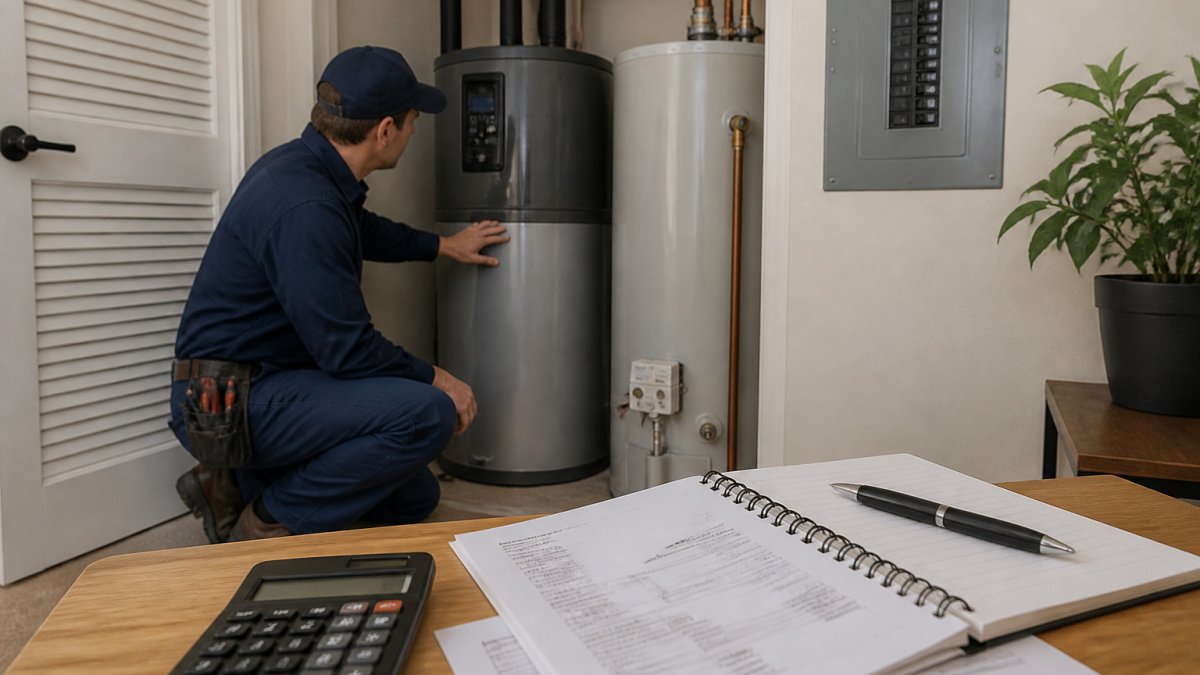
The itemized structure of an installed price
A transparent quote separates at least six lines. Ask for each one in writing:
- Equipment and warranty, the unit itself, plus any manufacturer extended warranty. This is the only line that is identical across bidders for the same model number.
- Labor, hours times rate, plus helper time. Labor is the line most likely to be estimated rather than fixed.
- Electrical work, dedicated circuit, wire run, breaker, disconnect, and any panel or service upgrade.
A quote that collapses these into one number is not necessarily dishonest, but it removes your ability to compare bids and to see where a change order could appear later.
Why two bids for the same house can differ so much
The largest swing is almost always electrical. A straightforward swap where the panel has spare capacity and a dedicated circuit already exists is a very different job from a home that needs a new circuit run or a panel upgrade.
The second swing is location.
A third swing is scope creep hidden in the bid. Relocating the unit, adding a drain pan, or upgrading the shutoff valve are small line items individually but add up.
A sample itemized scenario
Here is how the same unit can land at two very different installed prices. These are illustrative structures, not quotes.
Scenario A, straightforward replacement. Existing electric resistance tank in a basement, dedicated circuit already present, floor drain within reach, unit stays in the same spot.
- Equipment: the unit and standard warranty
- Labor: a few hours for a like-for-like swap
- Electrical: reconnect to existing circuit, no new run
Scenario B, same unit, harder site. Garage install, no existing circuit, no drain, panel at capacity.
- Equipment: same unit
- Labor: longer, because of the new circuit and drain route
- Electrical: new dedicated circuit, breaker, disconnect, and a panel upgrade to create capacity
The gap between A and B is driven almost entirely by electrical and drainage, not by the unit.
When you collect bids, give every installer the same written scope: current tank size and type, panel photo, install location, and whether a drain exists. Bids built on the same inputs are comparable; bids built on guesses are not.
Electrical capacity, wiring and circuit upgrades
Heat pump units draw electricity, and many homes need a dedicated circuit. Before you commit to a model, confirm your panel has spare capacity. If it does not, a panel upgrade may be needed. Wiring distance from the panel to the install location can also affect labor.
Condensate drainage, permits and labor rates
Heat pump water heaters pull heat from surrounding air and produce condensate that must drain properly. Some installs need a drain line or pump, which adds cost. Confirm the drainage plan in writing. Permits and inspections vary by locality, and fees are set by your local authority. Labor rates differ by region and job complexity, so request the labor rate and estimated hours to compare bids fairly.
A low unit price can hide a high installed cost. If one bid is far below the others, check whether electrical, drainage, permit, and removal are actually included, or priced as extras later.
The installed price breaks into separate line items, and each one is worth checking when you compare bids.
| Line item | What it covers | Why it varies |
|---|---|---|
| Equipment and warranty | The unit plus any extended warranty | Same for the same model number |
| Labor | Hours times rate, plus helper time | Most likely to be estimated |
| Electrical work | Dedicated circuit, breaker, panel upgrade | Driven by panel capacity |
| Plumbing changes | Flex connectors, valves, relocated lines | Depends on unit placement |
| Condensate management | Gravity drain, pump or neutralizer | Depends on whether a drain exists |
| Permit and inspection | Local fee and inspection time | Set by your local authority |
| Removal and disposal | Haul-away of the old tank | Varies with job scope |
Heat Pump Water Heater Rebates 2026 and Tax Credits
Incentives can lower what you pay, but eligibility rules change. Federal tax credits, state programs and utility rebates each have their own requirements, including income limits, equipment standards and installation timing.
Count incentives only after you confirm eligibility. Your net cost is the installed price minus any credits you qualify for, and that net figure is the one to compare against your existing setup.
Heat Pump Water Heater Operating Cost and Energy Savings
Operating cost depends on your electricity rate, household hot water use and the efficiency of the unit. Heat pump models move heat rather than generating it from scratch, which is why they typically use less electricity than standard electric resistance tanks (Purchasing Energy-Efficient Residential Water Heaters).
Savings vary. A household that runs hot water heavily will see a different bill than a couple that uses little. Ask for the unit’s rated efficiency and estimate your own use before assuming a specific monthly saving.
Heat Pump Water Heater Payback Period and Lifetime Cost
Payback period is how long your energy savings take to cover the extra upfront cost. The formula is simple: divide the net installed cost difference by your annual energy savings. The hard part is the inputs, and most guides stop before showing them. This section walks through a like-for-like comparison so you can plug in your own numbers.
Set consistent assumptions first
A fair comparison uses the same household, the same hot-water demand, and the same service life for every option. Change one assumption between columns and the comparison is meaningless. Use these as your starting frame:
- Same household and demand, the same number of people and the same daily hot-water use for every option.
- Same service life, use the manufacturer’s expected life for each type so you are comparing total cost over the same years, not a short window that favors one option.
- Same energy prices, your current electricity rate and, if you are comparing against gas, your current gas rate. Note that electricity and gas prices do not move together, which is itself a risk factor.
A worked comparison structure
Rather than a single number, build a small table with one column per option: heat pump, gas tank, and electric resistance tank. For each, fill in:
- Net installed cost, installed price minus any incentive you have confirmed you qualify for.
- Annual energy cost, your rate times the unit’s estimated annual energy use for your demand.
- Annual maintenance, a realistic allowance, not zero.
- Service life in years, from the manufacturer’s documentation.
- Lifetime cost, net installed cost plus (annual energy plus annual maintenance) times service life.
Payback is then the net installed cost difference between the heat pump and the alternative, divided by the annual energy savings. A shorter payback means the unit pays for itself sooner.
The number that matters is lifetime cost, not first cost. A cheaper unit that uses more energy can cost more over its life, and a higher-priced unit with a long service life can win on total cost even with a slower payback.
Sensitivity: what changes the answer
Three variables move payback more than anything else, and you can test each one yourself:
- Electricity rate. A higher rate makes heat pump savings larger and payback shorter, but it also raises the operating cost of every electric option, so compare on the same rate.
- Household hot-water demand. A large household uses more hot water, which widens the dollar gap between efficient and inefficient units. A low-use household sees smaller savings and a longer payback.
- Climate and install location. A heat pump water heater pulls heat from the surrounding air, so a cold location affects performance and may require a different model or placement. In a conditioned space, the unit also cools and dehumidifies the air, which some homeowners value and others do not.
Run the comparison at your current rate and at a modestly higher rate to see how sensitive the payback is. If the payback only works at today’s rate, that is worth knowing before you buy.
Incentives change the net number, not the comparison
Apply incentives only after you confirm eligibility, and apply them consistently. A federal tax credit, a state program, and a utility rebate each have their own rules, and not every household qualifies for every one.
Homeowners with an aging tank sometimes wonder whether repair is still the smarter choice. Our article on whether a 12-year-old water heater is worth repairing walks through that decision, and it is worth reading before you run the lifetime numbers on a replacement.
Ask each installer for the unit’s estimated annual energy use for your household size, not the label’s default. The label figure is a starting point; your demand is what determines the actual bill.
Planning Your Heat Pump Water Heater Installation with Classic Plumbing Solutions
Good planning starts with a site assessment, not a catalog page.
Start with a clear scope. Our water heater replacement services guide explains what the full process involves from start to finish.
Before hiring any installer, review our guide to verifying plumbing company legitimacy and confirm licensing and insurance in writing.
Heat pump water heater cost in 2026 varies with your home, so the most useful number is the one written for your specific site.
Frequently Asked Questions
Is there a federal tax credit for heat pump water heaters in 2026?
Federal tax credit eligibility for heat pump water heaters depends on the current Internal Revenue Code provisions and whether the credit is still available for the year you install. Because federal incentive rules change, confirm the current status with a tax professional or the IRS before budgeting. Many homeowners also check state and local utility rebate programs, which often run alongside or independent of federal credits. Final eligibility is determined by the program administrator and your tax situation.
How much should it cost to install a heat pump water heater?
Installed cost includes the unit, labor, electrical work, condensate drainage, permits and any venting or plumbing changes. Pricing depends on tank capacity, the condition of your electrical service, the location of the unit and local labor rates, so a single national figure is rarely accurate. Request a written, itemized estimate that separates equipment from installation so you can compare quotes on the same basis. Classic Plumbing Solutions provides upfront pricing and obtains customer authorization before any work begins. Contact the company directly for a current quote tailored to your home.
Is a heat pump water heater worth the higher upfront cost?
Whether it is worth the higher upfront cost depends on your household hot water use, your electricity rates, available rebates and how long you plan to stay in the home. Heat pump models generally use less electricity than standard electric resistance tanks, which lowers operating cost over time. Compare total cost of ownership over the expected life of the unit rather than the purchase price alone. A licensed plumber can evaluate your space, electrical capacity and usage so the comparison reflects your actual home.
What are the downsides of a heat pump water heater?
Heat pump water heaters need adequate installation space with airflow, and they can be louder than standard tanks and may cool the surrounding room, which matters in a small closet or a garage in winter. They also require a condensate drain and may need electrical upgrades in some homes. Units rely on the surrounding air temperature for efficiency, so performance can drop in very cold spaces. Discuss these site-specific factors with your installer before purchase.

