

Table of Contents
- How to Avoid Surprise Plumbing Charges: Start With a Written Estimate
- Understand the Plumbing Repair Cost Breakdown
- Questions to Ask a Plumber Before Hiring
- How to Compare Plumbing Quotes Side by Side
- Flat-Rate vs. Time-and-Materials Pricing
- Approve Additional Work With a Change Order
- What to Do When You Get an Unexpectedly High Bill
- Conclusion
- Frequently Asked Questions
Last Updated: October 17, 2026
How to Avoid Surprise Plumbing Charges: Start With a Written Estimate
The best way to avoid surprise plumbing charges is simple: get everything in writing before anyone touches a pipe. At Classic Plumbing Solutions, we’ve worked in homes around the Roanoke Valley since 1980, and jobs that start with a signed estimate rarely end in a billing fight.
A written plumbing estimate lists the scope of work, the price, and what the price does not cover. That last part matters most, most billing disputes start with work nobody defined up front.
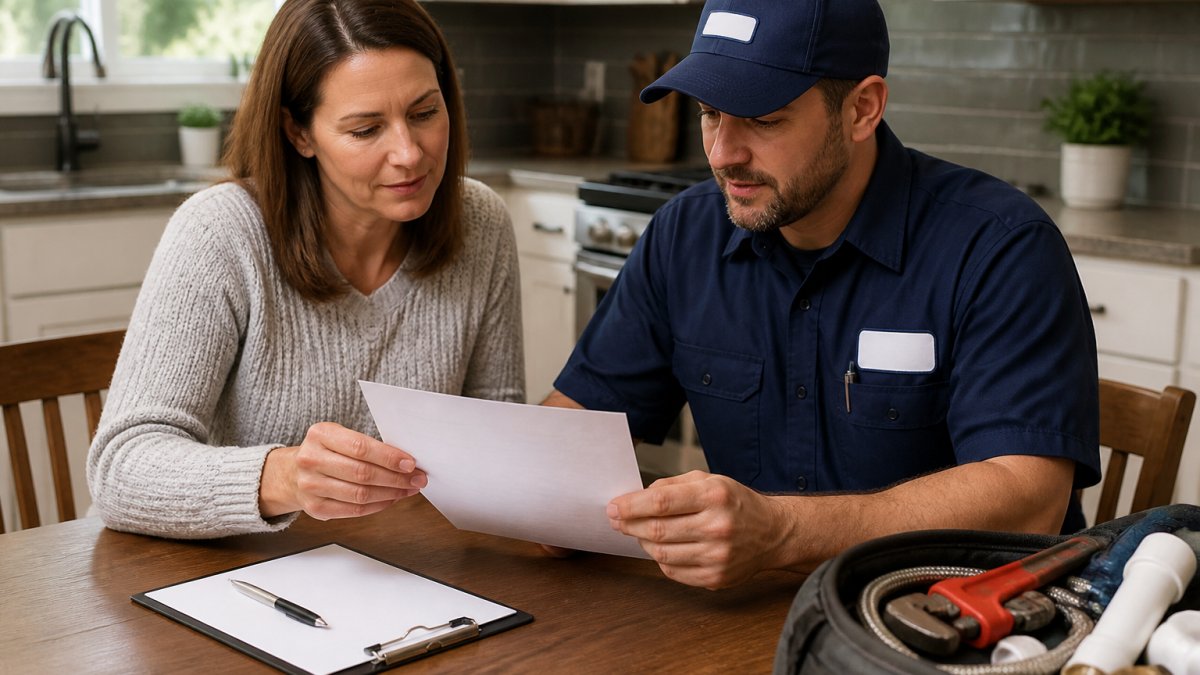
What a Written Plumbing Estimate Should Include
Ask for these items, and walk away if a plumber won’t put them on paper:
- The scope of work in plain language
- Labor costs, listed as an hourly rate or a flat-rate pricing total
- Parts and materials, itemized or listed as an allowance
A one-line quote that says “fix leak, $X” is a guess with a number attached. You want a cost breakdown you can read line by line.
Understand the Plumbing Repair Cost Breakdown
A plumbing repair cost breakdown separates your bill into four parts: labor, parts and materials, fees, and any permits or taxes. Knowing these parts lets you spot a padded bill before you pay it.
Here’s how each piece works:
| Charge Type | What It Covers | What to Confirm |
|---|---|---|
| Labor | Time on the job at an hourly rate | Whether the clock starts at arrival or at the door |
| Parts and materials | Pipes, fittings, fixtures, sealant | Whether markup is included or added later |
| Service-call or trip fee | Getting the plumber to your home | Whether the fee is credited toward the repair |
| Diagnostic fee | Finding the problem | Whether it applies to the final cost |
Many homeowners assume the trip fee vanishes once they hire the plumber. Confirm it in writing.
Service-Call, Trip, and Diagnostic Fees
These three fees are where hidden fees hide. A service-call fee covers the visit. A trip fee covers travel. A diagnostic fee covers the inspection that finds the problem.
Ask one direct question: “Is this fee credited toward the repair if I approve the work?” If the answer is yes, get it in the estimate. If the answer is no, you now know the real starting cost.
Questions to Ask a Plumber Before Hiring
Asking the right questions before you hire is the cheapest insurance you’ll ever buy:
- Are you a licensed plumber, and can I see the license number?
- Do you carry insurance coverage for damage to my home?
- Will I get a written quote before work starts?
- How do you handle additional work you find mid-job?
- What is your emergency rate and after-hours charge?
- Can you provide references from recent jobs?
- What does your warranty cover, and for how long?
That last question separates serious shops from the rest. A warranty that covers parts but not labor leaves you paying twice for the same failure.
Ask for the license number and check it against your state’s licensing board before the truck arrives. It takes two minutes and filters out a lot of problems.
How to Compare Plumbing Quotes Side by Side
Comparing plumbing quotes means comparing scope, not just totals. A lower number with a thinner scope is often the more expensive choice.
Use this approach:
- Line up the multiple quotes next to each other
- Check that each one covers the same scope of work
- Compare labor costs and parts and materials separately
One plumbing inspection may turn up three problems. If one quote covers all three and another covers one, the totals tell you nothing until you match the scope.
Flat-Rate vs. Time-and-Materials Pricing
Flat-rate pricing quotes one price for the whole job; time-and-materials pricing bills hours worked plus parts used.
Flat-rate pricing protects you from a slow technician. The price is the price, even if the job runs long.
Time-and-materials pricing can cost less on a simple repair.
Ask which model the plumber uses before work starts. Then ask what happens if the job runs past the estimate.
Never let a plumber switch from flat-rate to time-and-materials mid-job without a signed change order. That switch is how a quoted repair turns into a bill you didn’t agree to.
Approve Additional Work With a Change Order
A change order is a short written approval for work added after the original estimate, listing the new work, added cost, revised completion time, and your signature.
Most homeowners never see a change order because they never ask for one. The plumber finds a second problem, mentions it verbally, and the invoice includes a line you never agreed to.
What a Change Order Should Contain
A usable change order is short, one page is plenty, but it must include these fields:
- Original estimate reference (date and estimate number, if one was issued)
- Description of the newly discovered work in plain language
- Reason the work is necessary (safety, code, preventing further damage)
A napkin with a number on it is not a change order. Ask for the fields above in writing before any added work begins.
A Script You Can Use Mid-Job
When the plumber says, “While I was in there, I found X and it’ll be another $Y,” respond with this:
“Thanks for flagging that. Before you touch it, please write down what the new work is, why it’s needed, and the added cost on a change order. I’ll review it and sign if I approve. If I don’t sign, please stop at the original scope and leave the new issue documented so I can decide later.”
That script stops work, forces a written record, and preserves your right to decline. A licensed plumber will not object; one who pushes back on written approval is telling you something about how the rest of the job will go.
Handling the Three Common Pushbacks
“We don’t do change orders on small jobs.” Small jobs are exactly where verbal approvals turn into disputes.
“The price will go up if we stop to write it down.” The price is already going up, the question is whether you agreed to it.
“It’s a safety issue, we have to fix it now.” Safety issues still get a written number before work continues.
Never let a plumber switch from flat-rate to time-and-materials mid-job without a signed change order. That switch is how a quoted repair turns into a bill you didn’t agree to. If the pricing model changes, the change order must say so explicitly.
Decline in Writing, Not Verbally
If you decline added work, put the decline in writing, even a text message works: “I decline the additional $X for the shutoff valve replacement as of [date]. Please complete only the original scope.” A written decline protects you if the plumber later claims the work was authorized and documents the issue for a future visit.
The single rule that prevents most billing surprises: no added work without your written approval, and no verbal approvals, ever. Every other tip in this guide supports that one.
What to Do When You Get an Unexpectedly High Bill
An unexpectedly high bill is not the end of the conversation. Start by reviewing the bill line by line against your written estimate, then follow a documented process, a dispute without a paper trail is just a complaint.
Step 1: Build Your Comparison File
Before you call anyone, assemble these documents in one place:
- The original written estimate (or the text/email version)
- Any change orders you signed
- The final invoice
Put the estimate and invoice side by side and highlight every line that does not appear on the estimate or a signed change order. That highlighted list is your dispute.
Step 2: Request an Itemized Explanation in Writing
Call the business and ask for an itemized invoice if you only received a total. Then follow up in writing, email is best, with a short, factual message:
“I received invoice #[number] dated [date] for $[amount]. My signed estimate dated [date] was for $[amount]. The invoice includes $[amount] in charges I do not see on the estimate or on any change order I signed. Please provide an itemized breakdown of those charges, including labor hours, parts, and the authorization for each item, within 10 business days.”
Keep the tone neutral. You are building a record, not winning an argument yet. Most legitimate shops will respond with a corrected invoice or a clear explanation once they see you are organized.
Step 3: Know What You Are Actually Disputing
Unexpectedly high bills usually trace to one of four causes, and each has a different remedy:
| Cause | What It Looks Like | Your Move |
|---|---|---|
| Undefined scope | Invoice includes work the estimate never mentioned | Request itemization; dispute unapproved lines |
| Work done without approval | No change order exists for added work | Cite the missing authorization in writing |
| Pricing model switch | Flat-rate quote became hourly billing mid-job | Demand the signed change order authorizing the switch |
| Billing error | Duplicate line, wrong hourly rate, math error | Request a corrected invoice |
Naming the cause in your written dispute makes it much harder for the business to respond with a vague answer.
Step 4: Escalate in Order
If the written request does not resolve the issue, escalate in this sequence:
- Owner or manager, ask for a written response, not a phone call
- State licensing board, most states license plumbers and accept complaints about billing and workmanship; ask for the complaint process in writing
- State consumer protection office, the attorney general’s consumer division in most states accepts complaints about home-service billing
- Better Business Bureau, useful mainly as a public record; it does not adjudicate disputes
- Small claims court, for amounts within your state’s limit, usually a few thousand dollars; filing fees are typically modest
Reference each prior step in writing. “I contacted your office on [date] and have not received a response” is a powerful sentence in an escalation letter.
Step 5: Protect Yourself From Retaliation
Do not withhold payment for work you clearly authorized while disputing the rest. Pay the undisputed portion in writing, “Enclosed is $[amount] for the work covered by the original estimate; the remaining $[amount] is in dispute”, and keep the disputed amount in reserve.
Put every communication in writing, even if you also talk by phone. A short follow-up email, “To confirm our call today, you agreed to send a corrected invoice by [date]”, turns a verbal promise into a record.
A final cost that lands far above the estimate is almost always preventable with a written estimate, a signed change order for anything added, and a documented dispute process when something goes wrong. The paperwork is the protection.
Conclusion
Most surprise plumbing charges come from one gap: work never defined in writing. A written estimate, a clear scope of work, and a signed change order for anything added close that gap. Ask the questions, compare quotes on scope rather than total, and never approve added work on a handshake, then the bill at the end will match the number you agreed to at the start.
Frequently Asked Questions
What should a plumbing estimate include to prevent surprise charges?
A written plumbing estimate should list the scope of work, labor costs and hourly rate, parts and materials, service-call or diagnostic fees, estimate exclusions, taxes and surcharges, and payment terms. It should also state how additional work gets approved. If a plumber hands you a single number with no breakdown, ask for an itemized version before you sign. Getting the estimate in writing gives you a document to compare against the final invoice, which is the simplest way to avoid surprise plumbing charges.
Can a plumber charge more than the original estimate?
A plumber can charge more only when the scope of work changes, such as a hidden leak or a corroded fitting found after work starts. The difference is whether you approved the extra cost first. Ask for a change order or written authorization before any additional work proceeds, and confirm the new price in writing. If a bill arrives higher than the estimate with no prior approval, review the invoice line by line, ask for the cost breakdown, and request an explanation in writing before paying.
What questions should I ask a plumber before hiring to avoid hidden fees?
Ask whether the service-call or trip fee is separate from the repair cost, whether the quote is flat-rate or time-and-materials, and what happens if the job takes longer than expected. Confirm the hourly rate, how parts are priced, and whether emergency or after-hours rates apply. Ask for the license number, insurance coverage, and references, and get the answers in writing. Comparing multiple quotes with the same questions makes it easy to spot hidden fees and pick the clearest offer.
How do I respond to a disputed or unexpectedly high plumbing bill?
Start by reviewing the itemized invoice against your written estimate and any approved change orders. Note every line that differs, then contact the company in writing and ask for a cost breakdown and an explanation of the additional charges. Confirm in writing what was authorized and when. Many disputes come down to work done without prior approval, so keep your estimate, texts, and emails together. If the company will not explain the charges, ask for a supervisor and put your request for a corrected invoice in writing.
