

Quick Summary
Start by checking whether low water pressure affects only the shower or your whole home. If only the shower is weak, clean the showerhead and its screen, then check the stop valves, hot and cold supply, and shower filter or flow restrictor. If every fixture is weak, test static pressure, which typically runs between 40 and 80 psi.
- Run the kitchen and bathroom sinks while the shower runs to see if the problem is local.
- Soak a clogged showerhead in white vinegar for one to several hours, then scrub and rinse the nozzles.
- Time how long a one-gallon bucket takes to fill to measure flow in gallons per minute.
- Make sure the shutoff valves on both hot and cold supply lines are fully open.
- Call a licensed plumber if pressure is low at every fixture and a gauge reads below 40 psi.
Table of Contents
- Start With a Simple Test: Is It Only the Shower?
- Diagnose the Cause: A Step-by-Step Decision Tree
- Clean a Clogged Showerhead and Remove Mineral Deposits
- Shower pressure low all of a sudden: Causes and Fixes
- Increasing Shower Pressure Without a Pump or Regulator Change
- Checking and Adjusting a Shower Water Pressure Regulator
- When to Stop DIY and Call a Licensed Plumber
- Frequently Asked Questions
Start With a Simple Test: Is It Only the Shower?
Low water pressure in a bathroom shower is one of the most common plumbing complaints homeowners raise. The good news is that the fix often starts with one simple test.
Turn on the kitchen sink, then the bathroom sink, and then flush a toilet while someone watches the shower. If every other fixture runs strong, the cause is almost certainly local to the shower.
No water pressure in shower but plenty everywhere else
When the shower is the only weak spot, the cause sits in the shower itself. Common culprits include a clogged showerhead, mineral buildup in the arm, a clogged shower filter, or a flow restrictor. The rest of your plumbing is working, so you can focus your effort on the shower fixture.
Distinguishing a shower-only issue from a whole-home issue
A whole-home problem usually shows up everywhere at once, and it may come with other warning signs. Watch for these clues:
- Every faucet and toilet fills slowly
- Pressure drops at the same time of day across the house
- Neighbors on the same street report similar problems
If you see these signs, the issue may involve the water utility, a pressure regulator, or a supply line. In that case, the fixes in this guide will not solve it on their own.
Diagnose the Cause: A Step-by-Step Decision Tree
Work through these questions in order. Each answer narrows the cause and tells you which fix to try next. Keep a notepad handy and record what you find at each step.
- Is the weak spray only in this shower? Run the bathroom sink and the kitchen sink at the same time. If both run strong, the problem is local to the shower. If every fixture is weak, skip to the whole-home checks below.
- Does the spray look uneven, or are some nozzles dry? If yes, the showerhead is likely clogged with mineral deposits or debris. Go to the cleaning section.
- Is the problem only with hot water, or only with cold? Turn the handle fully to hot, then fully to cold. If one side is weak, the cause is on that supply side: a partially closed stop valve, a clogged cartridge port, or a water-heater issue on the hot side.
- Did the pressure drop suddenly, or has it faded over months? A sudden drop points to a recent change: plumbing work, a closed valve, a failed cartridge, or a supply disruption. A gradual decline points to scale buildup or a worn showerhead.
- Is the flow still weak after cleaning the showerhead and screen? If yes, check the shower filter, the flow restrictor, and the shower hose before moving to the valve.
Measure flow rate before you assume it is a pressure problem
Pressure and flow rate are not the same thing. Pressure is the force pushing water through the pipes, measured in pounds per square inch (psi). Flow rate is the volume delivered over time, measured in gallons per minute (GPM). A shower can feel weak because the pressure is low, because the flow is restricted, or because the spray pattern is poor even at normal flow.
Run a bucket-and-timer test to separate the two:
- Remove the showerhead or leave it in place, whichever is easier.
- Hold a one-gallon bucket under the full stream and time how long it takes to fill.
- Divide 60 by the number of seconds. For example, 24 seconds to fill one gallon equals 2.5 GPM.
A showerhead rated at 2.5 GPM or less is normal under federal efficiency standards, so a reading in that range does not mean the fixture is broken (Best Management Practice #7: Faucets and Showerheads). If the bucket fills in far more time than the showerhead’s rated flow suggests, you have a restriction or a supply problem, not just a weak spray pattern. If the flow measures close to the rated GPM but the spray still feels weak, the issue is the showerhead pattern or clogged nozzles, not the pressure.
Isolate hot versus cold and single-handle valves
A single-handle shower valve mixes hot and cold water inside a cartridge. If only hot water is weak, check the hot-side stop valve under the sink or behind the access panel, then check the water heater’s shutoff and supply. A clogged cartridge port on the hot side will starve the shower even when the cold side is fine. If only one temperature setting is weak, the cartridge is the prime suspect.
Whole-home checks
If other fixtures are also weak, test static pressure at an outdoor spigot or laundry faucet with a pressure gauge. Residential systems commonly run between 40 and 80 psi. A reading well below that range points to a pressure-reducing valve set too low, a supply-line problem, or a utility issue.
The article’s decision tree boils down to a few checks, each with a likely cause and the fix to try next.
| Check | Likely cause | Fix to try next |
|---|---|---|
| Weak spray only in the shower | Clogged showerhead or local restriction | Clean the showerhead and screen |
| Uneven spray or dry nozzles | Mineral deposits or debris | Soak in white vinegar, then scrub and rinse |
| Only hot or only cold is weak | Partly closed stop valve or clogged cartridge port | Check stop valves, then inspect the cartridge |
| Pressure dropped suddenly | Closed valve, recent plumbing work, failed cartridge | Confirm valves are open, then flush the shower |
| Pressure faded over months | Scale buildup or worn showerhead | Clean or replace the showerhead |
| Weak flow after cleaning | Shower filter, flow restrictor, or shower hose | Check the filter, restrictor and hose before the valve |
| Every fixture weak | Regulator set too low or supply issue | Test static pressure, usually 40-80 psi |
Clean a Clogged Showerhead and Remove Mineral Deposits
A clogged showerhead is the most common and cheapest problem to fix. Hard water leaves limescale and mineral deposits inside the small nozzles, which blocks the spray.
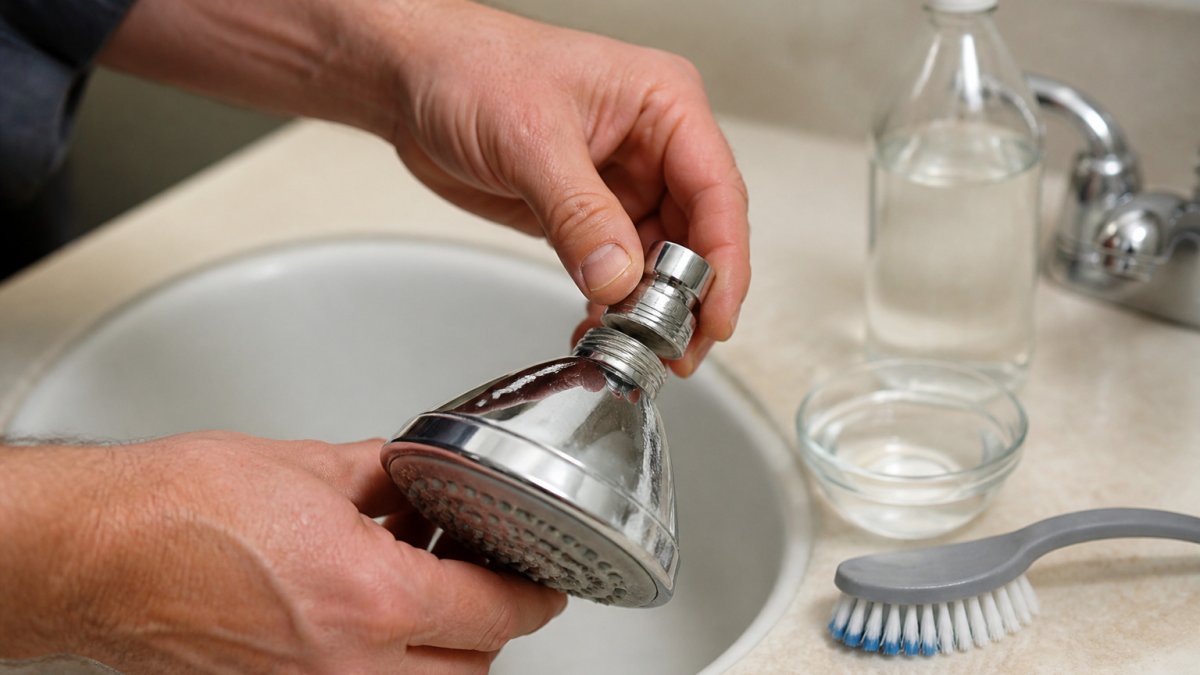
Start by unscrewing the showerhead by hand. If it is stuck, wrap a cloth around it and use a pair of pliers gently. Then clear the nozzles with a small brush or a toothpick, and rinse everything under running water.
Soaking the showerhead in white vinegar
For heavier buildup, soak the showerhead in white vinegar. Fill a plastic bag with vinegar and tie it around the head so the nozzles are fully submerged. Let it soak for one to several hours, depending on how thick the deposits are.
A common mistake is soaking a metal finish for too long. Check the manufacturer’s care instructions first, especially for brushed or painted finishes.
Checking or cleaning the shower filter and flow restrictor
Some showerheads have a small inline filter or a flow restrictor disc inside the connection. Debris can collect in these parts and cut the flow even when the nozzles are clean.
Unscrew the showerhead, look inside the connection, and remove any screen or filter you find. Clean it with vinegar and a soft brush. Do not remove a flow restrictor just to get more pressure.
Shower pressure low all of a sudden: Causes and Fixes
A sudden drop in shower pressure usually points to a specific, recent change rather than gradual wear. Start by checking the simplest explanations.
- Shutoff valve partly closed: Look for a valve under the sink or behind an access panel and make sure it is fully open.
- Recent plumbing work: Work on nearby pipes can leave debris in the lines, which clogs the shower filter or valve.
- Failed mixing valve cartridge: A worn cartridge can reduce flow, especially on one handle.
If the shutoff valve is fully open and the problem began after plumbing work, flush the shower by running it on full for a few minutes, then clean the showerhead. If that does not restore the flow, the cartridge or a supply line may need attention.
Increasing Shower Pressure Without a Pump or Regulator Change
You do not always need new equipment to improve shower pressure. Several low-cost steps can make a noticeable difference.
- Clean the showerhead and screen as described above.
- Replace an old hose that has kinks, leaks, or internal scale.
- Confirm the shutoff valves are fully open on both the hot and cold supply lines.
Keep your expectations realistic. These steps address blockages and restrictions. They cannot fix a weak supply from the street. If the house itself has low supply pressure, a plumber will need to test the main line.
Checking and Adjusting a Shower Water Pressure Regulator
Many homes have a pressure-reducing valve on the main water line, often near where the supply enters the house. This regulator keeps pressure at a safe level.
Before adjusting anything, attach a pressure gauge to an outdoor spigot or a laundry faucet and read the static pressure.
Adjust the regulator only if you are comfortable doing so. Turn the adjusting screw slowly and retest after each change.
When to Stop DIY and Call a Licensed Plumber
Most shower pressure problems are safe to handle with basic cleaning and a few checks. Some situations call for professional help right away, and a few are urgent. Use these thresholds to decide.
Stop and call a licensed plumber if:
- Pressure is low at every fixture in the house, not just the shower, and a pressure gauge reads below 40 psi at an outdoor spigot.
- You see water stains, damp spots, bubbling paint, or a musty smell near a wall, floor, or ceiling.
- Your water bill rises unexplained, which often signals a hidden leak.
Watch out: Never remove a flow restrictor to chase more pressure without checking the manufacturer’s guidance and any local efficiency rules. Restrictors are regulated components, and on many models they are built into the showerhead or valve body.
What professional help typically involves
A plumber will usually start with a static pressure test at a spigot and a flow test at the shower, then isolate the cause the same way this guide does. Common repairs include replacing a mixing-valve cartridge, cleaning or replacing a pressure-reducing valve, and clearing scale from the shower arm or valve body. Cartridge replacements are often a same-day job once the correct part is on hand; pressure-reducing valve replacement can take longer if the valve is stuck or the shutoff does not hold.
Safe DIY limits
Cleaning a showerhead, soaking it in vinegar, replacing a hose, and checking that stop valves are fully open are all low-risk tasks. Working on the valve body, the pressure-reducing valve, or any soldered or threaded connection inside a wall raises the risk of a leak you cannot see.
If you have worked through the decision tree, cleaned the showerhead and screen, confirmed the stop valves are open, and the flow is still weak, the next step is a professional diagnosis rather than more parts swapping.
Frequently Asked Questions
Can a clogged showerhead cause low water pressure?
Yes. Mineral deposits from hard water and small debris can clog the nozzles of a showerhead, reducing the water volume that exits the spray face even when supply pressure is normal. Unscrew the head, soak it in white vinegar for several hours or overnight, then scrub the nozzles with an old toothbrush and rinse. If the spray pattern returns, the showerhead was the problem. If not, check the shower valve, filter, and flow restrictor next.
Why is my shower pressure low when the rest of the house has normal water pressure?
When only one fixture is weak, the cause is almost always local to that fixture, such as a clogged showerhead, a blocked inlet filter, a flow restrictor, or a worn mixing valve cartridge. Test the sink and tub at the same time. If they are normal and only the shower is weak, work through the showerhead, then the filter, then the valve. If every fixture is weak, the problem is more likely the whole-home supply or a pressure regulator.
Can I increase shower pressure without installing a pump?
Often yes. Cleaning the showerhead, removing a clogged inlet filter, and checking that the shutoff valves under the fixture are fully open can restore flow without any new equipment. Replacing an old, restrictive showerhead with a higher-flow model that still meets local water-efficiency rules is another option. Pump installation should only follow a confirmed low-supply problem, and a licensed plumber should size and install one.
When should I call a plumber about low shower pressure?
Call a licensed plumber if weak pressure affects every fixture in the home, if it started suddenly with no obvious cause, if you suspect a failing pressure regulator or a corroded or leaking pipe, or if you see water stains, dampness, or a drop in pressure that worsens over time. Those signs point to supply or plumbing-system problems that cleaning cannot solve, and they can lead to leaks or damage if left alone.

